Is Sports Betting Legal in Georgia?
 by
Dan Favale
by
Dan Favale
SUMMARY
- Is sports betting legal in Georgia right now?
- Georgia sports betting laws explained
- What gambling is legal in Georgia today?
- Offshore sportsbooks available to Georgia players
- Prediction markets in Georgia
- Why Georgia still hasn’t legalized sports betting
- Georgia sports betting timeline
- When will sports betting be legal in Georgia?

Let’s answer the big question first. No, sports betting is not legal in Georgia. The state has no regulated online or retail sportsbooks, and major U.S. betting apps are not licensed there.
That puts Georgia in a shrinking group of holdout states. Our Georgia gambling guide covers the wider picture. This page focuses on the current law, why betting is still blocked, and what Georgians do in the meantime.
We track Georgia’s betting debate closely. The law has stayed put for years, despite strong public support.
For practical next steps, see our how to bet in Georgia guide and Georgia online gambling guide.
Is sports betting legal in Georgia right now?
Georgia does not license sportsbook operators, so there is no state-regulated way to place a sports bet online or in person.
Georgia does not license sportsbook operators, and the Georgia General Assembly has not passed a law creating a state-regulated sportsbook market.
That means the big national apps aren’t here. You can’t use FanDuel, DraftKings, or BetMGM in Georgia. They only operate in licensed states.
So what do Georgians actually use? Many turn to offshore sportsbooks. These operate outside the United States and accept Georgia players.
There’s an important distinction here. State-licensed books answer to a U.S. regulator. Offshore books don’t. You can compare them on our reviews page.

Can you bet from your phone in Georgia? Not through any legal, state-regulated sportsbook app. Some offshore sportsbooks may be accessible on mobile, but they are not licensed by Georgia regulators.
What about enforcement? The state focuses on operators, not individual bettors. Still, the activity isn’t legally protected. There’s no Georgia regulator to back you up.
Georgia isn’t alone, but it’s an outlier. By 2026, the large majority of states allow some sports betting. Georgia remains one of the biggest holdouts left.
| Question | Answer |
| Legal state-regulated sports betting? | No |
| Retail sportsbooks? | No |
| Legal online sportsbooks? | No |
| FanDuel, DraftKings, BetMGM? | Not available |
| Offshore sportsbooks? | Available, not state-regulated |
The quick takeaways:
- No Georgia-licensed sportsbook exists, online or retail.
- Major U.S. apps like FanDuel and DraftKings are not live in the state.
- Offshore books accept Georgia players but aren’t state-regulated.
Georgia sports betting laws explained
Georgia’s gambling rules are some of the strictest in the country. Here’s the framework in plain English.
It starts with the state constitution. Georgia’s Constitution bans most gambling outright. The lottery is the main carve-out, approved by voters in 1992.
That constitutional ban is the core hurdle. To add sports betting, lawmakers face two possible paths. The two sides don’t agree on which to take.
You can track active bills at the Georgia General Assembly site. So far, none has crossed the finish line. The legal status stays unchanged.
There’s one more wrinkle. Casinos and pari-mutuel betting face the same constitutional wall. Sports betting often gets bundled into those debates, which further slows it down.
Why does the path matter so much? It changes who gets the final say. An amendment hands the decision to voters. A statute keeps it inside the legislature.
Supporters of the lottery path point to 2024. That year, the Senate passed a lottery-run framework. It treated betting as lottery gaming, with no amendment required.
Opponents argue that reading stretches the state constitution too far. They believe only voters can authorize new gambling. Courts could ultimately have to settle the question.
That uncertainty alone gives cautious lawmakers pause. No one wants to pass a bill a court might toss. So the safer political move is to wait.
What gambling is legal in Georgia today?
Georgia does allow some gambling, just not much. Here’s what sits on the legal side of the line.
The Georgia Lottery is the big one. Voters approved it in 1992. It funds the HOPE Scholarship and pre-K programs across the state.
Charitable bingo and raffles are legal too. Licensed nonprofits can run them under strict rules. The GBI oversees bingo, and the Secretary of State explains Georgia’s charity bingo rules.
That’s essentially the full legal list. Lottery, bingo, and raffles make up legal Georgia gambling. Everything else sits outside the law.
So what’s not legal?

Commercial casinos are banned. So are poker rooms, online casinos, and sports betting. Pari-mutuel horse racing isn't authorized either.
Daily fantasy sports occupy a middle ground. Apps operate in Georgia, and many residents play. The state hasn’t firmly settled its legal status.
The lottery is woven into Georgia life. Scratch-offs, draw games, and multi-state jackpots are all available. Proceeds have funded education for decades.
Bingo and raffles come with strict conditions. Only approved nonprofits can host them. The rules cap prizes and require licensing and record-keeping.
Sweepstakes-style games also exist online. They typically use dual-currency or prize-redemption models, but they should not be described as legal Georgia casinos or sportsbooks.
Social casinos round out the online options. They are usually free-to-play or coin-based products, but users should check each platform’s Georgia terms and redemption rules.
| Activity | Legal in Georgia? |
| Georgia Lottery | Yes |
| Charitable bingo | Yes (licensed) |
| Charitable raffles | Yes (licensed) |
| Daily fantasy sports | Operates, status debated |
| Sports betting | No |
| Commercial casinos | No |
| Online casinos | No |
| Pari-mutuel horse racing | No |
| Prediction markets | Separate federal category; rules are evolving |
Offshore sportsbooks available to Georgia players
With no legal in-state option, many Georgians look offshore. Let’s explain what that means. And let’s be honest about the trade-offs.
Offshore sportsbooks are based outside the United States and are not licensed by Georgia regulators. Some may accept Georgia users, but account availability, age rules, payment options, and withdrawal terms vary by operator.
A few names come up often. Bovada, BetOnline, and MyBookie are commonly used offshore options for Georgia players. Each carries sports markets such as moneylines, spreads, totals, props, and live betting.
Why do some Georgians look at them? They offer a traditional sportsbook-style experience while Georgia has no state-regulated sportsbook market. The trade-off is that they operate outside Georgia oversight.
How do they differ from regulated U.S. books? The big one is oversight. A licensed U.S. book answers to a state regulator. An offshore book doesn’t. See our Georgia betting apps page for more.
- They accept Georgia players when no legal option exists.
- Wide markets, big bonuses, and fast crypto payouts.
- No U.S. or Georgia regulator stands behind them.
- Disputes are handled by the operator rather than a state body.
Banking sets offshore books apart. Many lean on crypto, since card payments are often declined. Bitcoin deposits and payouts are common.
The bonuses tend to run large. Welcome offers, reloads, and crypto boosts are standard. Just read the rollover terms before you commit.
Users should treat offshore sportsbooks as non-state-licensed options and review legal, tax, payment, and dispute risks before depositing.
Reputation is your best protection offshore. Long-running books have payment track records worth checking. Newer sites carry far more unknowns. A quick check of payout reviews goes a long way.
A note on offshore books: They operate outside Georgia and U.S. regulation. They aren’t state-licensed. Use them with a clear understanding of that trade-off.
Prediction markets in Georgia
Here’s an option many Georgians overlook. Prediction markets give sports fans a federally regulated way to play. They work even though sports betting remains illegal here.
Kalshi and Polymarket are two commonly discussed platforms in this category. Kalshi says it operates as a CFTC-regulated exchange, while Polymarket operates under a different model. Both let users trade contracts on real-world events, where a yes-or-no position moves with the market price.
Here’s why users compare them. Some prediction-market platforms operate under federal derivatives rules rather than state sportsbook licensing, but sports-event contracts remain a developing and legally contested category.
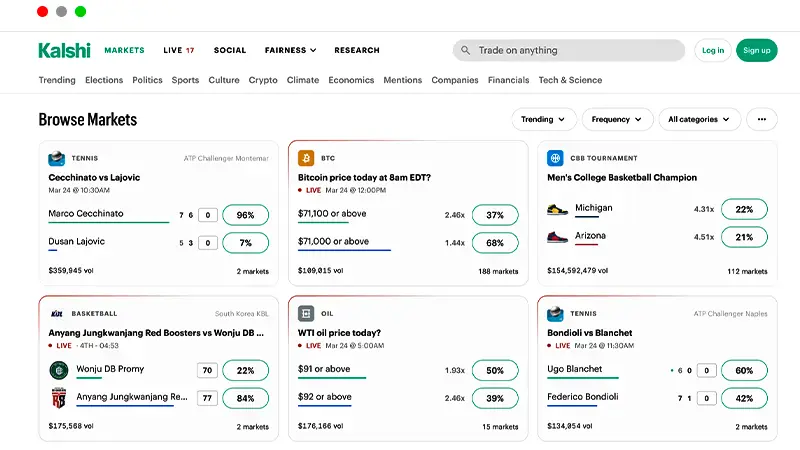
For Georgia fans, some event contracts may feel similar to sports betting markets. Availability changes by platform, event type, and regulatory environment, so users should check current platform rules before trading.
Georgia has not created a state-regulated sportsbook market, and prediction-market rules should be treated separately from Georgia sports betting law. Age, location, and market-access rules vary by platform.
The bigger picture stays unsettled, though. Other states have challenged sports contracts in court. The federal-versus-state question isn’t fully resolved. The status could shift.
Our take: prediction markets are worth knowing about, but tread carefully. Some platforms rely on federal derivatives rules, but sports-event contracts remain legally contested.
Why Georgia still hasn’t legalized sports betting
Georgia keeps trying and keeps falling short. So why does it stay blocked? A few forces are at work.
It’s not for lack of support. A 2025 poll found 63% of voters in favor. Our Georgia betting news page tracks the latest moves.
Pro sports teams and leagues back legalization too. Even the PGA Tour has urged action. Still, the votes haven’t been there.
There’s also a revenue angle pulling the other way. Supporters point to lost tax dollars. Neighboring states collect millions that Georgia leaves on the table.
Tennessee and North Carolina both legalized nearby. Their markets launched without political fallout. That example has nudged some Georgia lawmakers to reconsider.
Still, the coalition keeps fracturing. Casino backers want their piece included. Lottery purists want a clean, betting-only bill. The groups rarely line up.
Leadership matters too. Without a strong champion in both chambers, bills lose steam. A key sponsor’s departure in late 2025 didn’t help the cause.
The result is years of near-misses. Each side blocks the other’s preferred approach. Without compromise, the bills keep dying.
Georgia sports betting timeline
The push to legalize has a long, frustrating history. Here’s how it has played out.
It really began in 2018. That’s when the Supreme Court struck down the federal ban. States gained the power to legalize on their own.
Since then, Georgia has tried almost every year. Bills have come and gone. None has become law.
The 2026 session was the latest letdown. A constitutional amendment, HR 450, failed badly in the House. It got 63 votes, far short of the 120 needed.
Other 2026 bills stalled too. SB 208 died in committee. HB 910 and HB 686 went nowhere before the deadline.
A few moments stand out in that history. The 2024 Senate vote was the closest call. For a moment, a lottery-run model looked viable.
Then 2026 brought the hardest fall. The House rejected the amendment by a wide margin. That 63 to 98 vote showed how far apart the sides remain.
The pattern is consistent, though. Bills advance, build hope, then stall. Each session has ended with the same result.
Momentum has grown outside the Capitol, though. Polls, leagues, and committees now favor action. The gap sits between public opinion and legislative votes.
| Year | What Happened |
| 2018 | Supreme Court ends the federal ban; DFS apps take hold in Georgia. |
| 2019-2022 | Multiple sports betting bills were introduced, but none passed. |
| 2023 | Legislation gains traction but fails before adjournment. |
| 2024 | Senate approves a lottery-run framework; the House doesn’t pass it. |
| 2025 | Two House bills and one Senate bill stall out. |
| 2026 | HR 450 amendment fails 63 to 98; SB 208 dies in committee. |
When will sports betting be legal in Georgia?
Here’s the question everyone asks. When will Georgia finally legalize? We won’t pretend to know an exact date.
But we can map the realistic paths. The first runs through a constitutional amendment. That needs a two-thirds legislative vote, then voter approval.
On that path, the soonest is slow. An amendment would go to voters in a general election. A launch wouldn’t follow until the next year at the earliest.
The second path uses the lottery. A statute could authorize betting without a referendum. It would move faster, but its legality is contested.
For now, momentum exists, but votes don’t. Public support is high. The legislature remains split. That mix has stalled progress for years.
Our honest take: don’t expect a quick change. A breakthrough is possible in a future session. But Georgia has disappointed bettors many times before.
What should you watch for? A unified bill is the first sign. If casino and sports betting backers align, the odds improve.
A ballot referendum is the other signal. If an amendment clears the legislature, voters get the final word. Polls suggest they would likely approve.
Until then, the status quo holds. Check current Georgia legislative activity for any new movement. For now, patience is the only honest advice.
One thing is clear from the pattern. Change in Georgia comes slowly, if at all. We’d plan around the current rules, not a hoped-for launch.
Georgia Sports Betting FAQ
Find answers to common questions about Georgia sports betting laws, legal gambling options, offshore sportsbooks, and future legalization.
Some betting is, most isn’t. The Georgia Lottery, charitable bingo, and raffles are legal. Sports betting, casinos, and online casinos are not.
So the answer depends on the activity. If you mean sports betting, then no. The state has no legal sportsbooks, online or retail. Check the latest Georgia legislative status before relying on sportsbook availability.
Daily fantasy sports add a gray area. Apps operate, but the state has not fully clarified them. If a site offers sportsbook-style betting to Georgia users, it is not a Georgia-licensed sportsbook and may be operating offshore or under another non-sportsbook model.
Legally, the options are thin. There are no state-regulated online casinos or sportsbooks. Online lottery games are the main legal real-money option.
Many Georgians also use offshore sites and DFS apps. Offshore books aren’t state-regulated, though. DFS operates, but its legal status isn’t fully settled.
Sweepstakes-style sites are another online category users may encounter. They use virtual currency or prize-redemption mechanics, but they should not be treated as state-licensed Georgia casinos or sportsbooks.
The legal list is short. It covers the Georgia Lottery, charitable bingo, and charitable raffles. All three tie back to education or nonprofit causes.
Everything else is off-limits. That includes sports betting, commercial casinos, online casinos, and poker rooms. Pari-mutuel horse racing isn’t authorized either.
The common thread is purpose. Each legal form ties to education or charity. That framing helped them clear Georgia’s strict gambling rules. Anything resembling a casino or sportsbook stays banned. The line in Georgia is unusually firm. That makes it one of the most restrictive states for gambling.
Not through any legal, state-licensed sportsbook. None exists in Georgia. Both running a book and placing a bet are restricted under state law.
Some offshore sportsbooks may accept Georgia users, but they operate outside Georgia regulation and are not state-licensed. DFS apps, prediction markets, and social/sweepstakes-style products are separate categories, not legal Georgia sportsbooks.
We expect that to hold for a while. The 2026 push already failed. Without new legislation, the answer stays the same heading into the next session. Offshore remains the practical workaround for now. We’d weigh the lack of regulation before using one. In short, no legal Georgia sportsbook will take your bet today.
There’s no firm date. Lawmakers have failed to pass a bill every year since 2018. The 2026 effort fell short in March.
Legalization likely needs a constitutional amendment or a lottery statute. Neither has cleared the legislature yet. A future session could change that, but nothing is guaranteed.
Watch the legislative calendar for clues. A unified bill or a ballot measure would signal progress. Neither is on the table at the moment. We’ll refresh this page when that changes. Until a bill actually passes, treat any date as a guess. For planning today, assume the current rules stay in place.
 Online betting sites