 by
by
Wisconsin sports betting is expanding. Earlier this year, Governor Tony Evers signed into law Act 247.
With a stroke of a pen, Evers made online sports betting legal. See, Wisconsin already had betting, but it was under a lid. Only the tribes could offer it, and it all had to be done in-person at tribe-owned casinos in the state.
The new law would’ve changed that. Sports betting would still be tribal controlled — though they could partner with top sports betting apps — but they would now be allowed to offer mobile wagers.
In states where both mobile and retail betting are allowed, mobile accounts for 90 to 95 percent of all sports wagers. So the belief was that Wisconsin was about to blow the lid open on its betting industry.
Well, that is now up in the air. There’s a brand-new lawsuit in the state that’s trying to stop the implementation of this bill dead in its tracks. Keep on reading, and we’ll update you on the bonkers situation.
Lawsuit Says Wisconsin Can’t Do This
The lawsuit dropped on August 5, courtesy of the Wisconsin Institute for Law & Liberty (on behalf of the Brown County Taxpayers Association and Citizens Defending Liberty). The “smoking gun” in the lawsuit is the state donation itself.
See, way back in 1993, Wisconsin voters amended the state Constitution to say the Legislature can’t authorize new forms of gambling outside a few narrow exceptions —bingos, raffles, on-track betting, and the state lottery. Notice that doesn’t say sports betting? So the lawsuit contends lawmakers can’t legalize statewide mobile sports betting. Period.
Act 247 is ripping a page out of Florida sports betting to expand its industry. It’s called a “hub-and-spoke” model, and it works like this: a bettor could be sitting on their couch in Green Bay, but as long as the wager is processed through a server sitting on tribal land, the law treats that bet as tribal gaming. Before Florida found this loophole, it was believed tribal betting had to be physically done in-person on tribal land only.
The lawsuit says that’s nonsense. Lucas Vebber, who is the attorney representing Wisconsin Institute for Law and Liberty, argues the bet should be where the bettor is — not the server.
“You’re placing that bet in the state of Wisconsin. Your feet are firmly planted in the state of Wisconsin. Your phone is just connecting there. It’s just like, you know, if you’re connecting to Bermuda or something. You’re placing the bet in the state of Wisconsin. It’s just being processed on the server, and that’s why we would argue that federal law doesn’t preempt it here,” Vebber said.
But… that’s not the only thing the lawsuit claims is being violated here. So are equal-protection guarantees, since the tribes have sole access to this mobile market.
The tribes, of course, vehemently disagree. The Forest County Potawatomi Community pointed to a 2006 Wisconsin Supreme Court ruling that said gaming can be expanded when the state and tribes negotiate compact amendments, which they in fact did.
Evers Isn’t Backing Down From Lawsuit
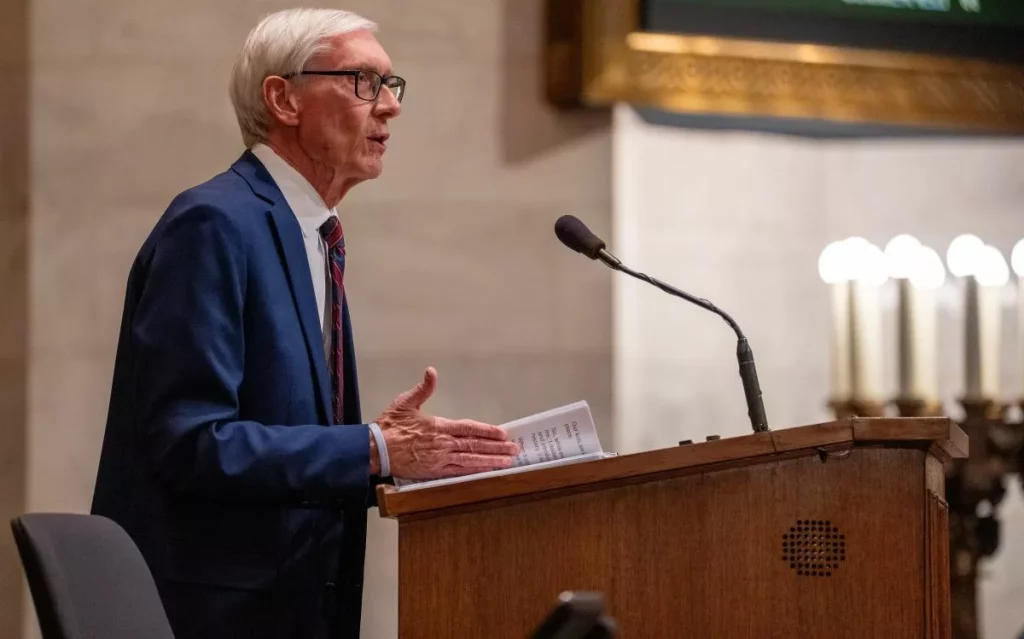
Governor Evers wasted no time responding to the lawsuit. His spokesperson Britt Cudaback said the administration plans to fight it and accused the suing organization of “actively working to undermine the sovereignty of the Tribal Nations in Wisconsin.”
It’s yet another challenge for Evers to get this bill going. You see, just because his ink is on the act doesn’t mean the industry was ready to launch for NFL betting. No, no, Evers still has to work out a deal with all 11 federally recognized tribes in the state. They have to come up with a joint agreement on how to handle the expansion, and well, getting all 11 tribal leaders to agree isn’t going to be easy.
Even if agreements are struck, Uncle Sam still gets a say. The compact amendments have to go through federal review under the Indian Gaming Regulatory Act before mobile wagering can launch in Wisconsin.
Now throw a constitutional lawsuit into the mix and Evers really has his work cut out for him. But if there’s a glimmer of hope for Evers, it’s that there is a precedent to suggest Wisconsin lawmakers are somewhat in the right here, and the lawsuit isn’t. We’ll explain in the next section.
Florida Proved This Is Legal
Remember how we said this model was borrowed from Florida? Well, it was, and they also showed there’s legal grounds for this working.
Down in the Sunshine State, the Seminole Tribe’s mobile sports betting setup was sued over and over for the same reason: wagers being processed through servers on tribal land. The lawsuits were enough for Hard Rock Bet to go offline for several months.
The lawsuits dragged through federal court for years, but the Seminole model survived. An appeals court sided with the tribe and the federal government, and in 2024, the U.S. Supreme Court declined to take up the case. That left Florida’s hub-and-spoke system standing — and all the lawsuits defeated.
Now, Wisconsin’s lawsuit isn’t identical. This one leans heavily on the state’s own Constitution. Still, Evers and the tribes can point to Florida and say this model works and was even given the green light by the highest court in the country. That’s a pretty strong argument.
 Online betting sites