 by
by
DraftKings CEO Jason Robins has conquered a lot of mountains in the sports betting world. He survived numerous attempts to ban daily fantasy sports — before legal betting was federally allowed.
Then when that federal ban was lifted, and the sports betting gates opened wide, he survived an onslaught of competition. He’s now in his eighth football betting season, all with DraftKings, the company he founded and has remained its CEO. Among all the top betting apps, DraftKings is a healthy second in market share across the country.
But want to know what mountain Robins has yet to topple? The Texas sports betting mountain. Despite lobbying on their end and other parties, Texas lawmakers have not budged one bit on allowing it. The Lone Star State is one of 11 without a legal marketplace.
And honestly, there are no signs that changes anytime soon. Texas lawmakers have repeatedly shot down sports betting bills — in Congress and in public, tearing up the industry in the media.
But instead of climbing the Texas mountain, Robins might have to walk around it completely with something new: prediction markets. Robins recently spoke at the 2025 BofA Gaming and Lodging Conference, where he signaled another way to get into Texas. Keep reading for full details.
Robins Sees Prediction Markets As A Backdoor
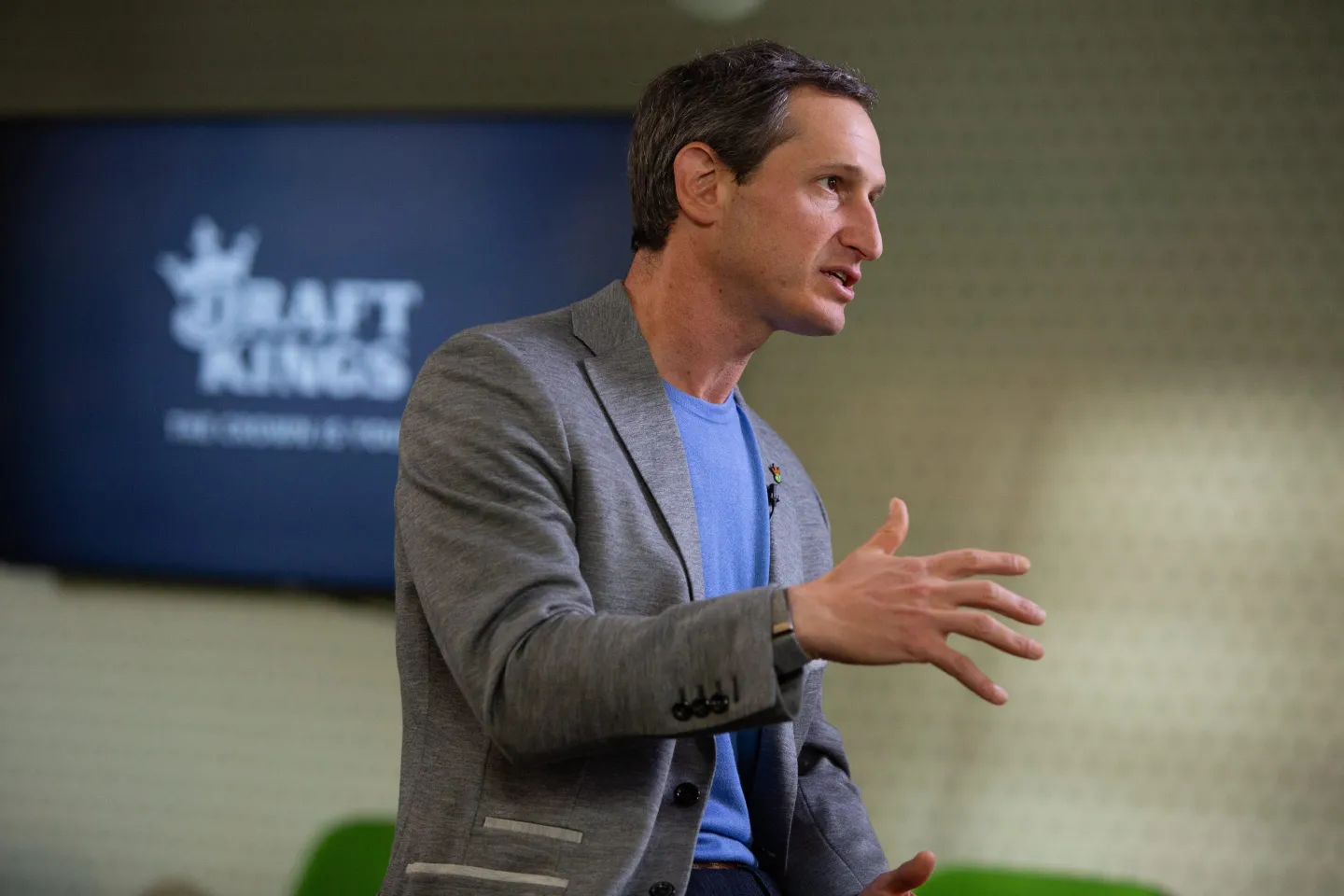
To be clear, Robins never mentioned Texas by name at the conference. However, he certainly inferred them when discussing states where sports gambling is not currently legal. Right now, the two big dominoes yet to fall are Texas and California. Both have huge, affluent populations that bookmakers are rushing to tap into, but can’t.
Derivative trading (the fancy name for prediction markets) is how Robins sees operators doing that. This is because prediction markets aren’t regulated like sportsbooks. They fall under federal commodities law, which means contracts can be traded in every state. Platforms like Kalshi have been pushing football contracts all fall, and the numbers are staggering so far (more on that later).
Robins knows this, and that’s why he’s publicly hinted that DraftKings could eventually roll out its own prediction market to capture states it’s normal sportsbook operation isn’t allowed in. They certainly aren’t the first toying with the idea either.
Flutter, FanDuel’s parent company, partnered with CME Group to launch its own exchange. Crypto.com teamed with Underdog. And Polymarket just got a green light from the CFTC to run its contracts legally nationwide (it was not allowed in the United States before). DraftKings can’t ignore that kind of momentum, not if it wants to hold onto its No. 2 market share behind FanDuel.
The Hurdles DraftKings Still Faces
Sure, this all sounds easy enough, but it’s a little more complicated than just spinning up another app or website. That’s because exchanges don’t run like sportsbooks. DraftKings has always played the house, setting the odds and cutting off sharp bettors when things get too risky. Prediction markets require liquidity providers — so-called market makers — to keep action balanced. Without them, markets dry up fast.
Kalshi learned that the hard way before Susquehanna International Group stepped in last year to prop up their trades. Imagine trying to cover a seven-figure swing bet, like the one Kalshi took on Trump during Election Night 2024, without a deep-pocketed market maker backing you. That’s the type of exposure Robins has never had to manage at DraftKings, where limits are their safety valve.
Then there’s the state politics. Sure, prediction markets are federally sanctioned right now, but DraftKings can’t risk burning bridges with regulators in states where it already makes hundreds of millions. Unlike Kalshi, which doesn’t answer to state-level commissions, DraftKings has to protect its standing in New Jersey, New York, Pennsylvania, and beyond. If it launches an exchange, many of those states could rightfully feel like DraftKings is trying to undercut them.
Even the product side is tricky. DraftKings runs one of the deepest betting menus in the country. Replicating that in a prediction market would be a nightmare without massive liquidity. Robins alluded to this, saying they’d have to limit contracts if they went that route. That would be a big shift for customers used to betting on everything from player props to micro markets.
Prediction Market Upside Is Huge
So yes, it’s not exactly easy for DraftKings to go all-in on trading contracts. But boy, the upside would certainly make the struggles worth it if they were to succeed.
Get a load of the latest numbers coming from Kalshi. This past weekend, trading volume on the platform blew past $260 million on Saturday — a new platform record — only to be shattered the very next day when action soared above $275 million. For perspective, that’s more than what Kalshi did on Election Day 2024, which was previously its all-time high at $245 million.
Prediction markets barely became a hot commodity this year too. If this continues to catch on, volumes should explode later this season and in the years to come.
So yes, there’s too much at stake for DraftKings not to participate here, especially since it looks like Texas will continue to hold them out of the state on the sportsbook front. This story is far from being fully written so we’ll be sure to stay on top of it with the latest developments.
 Online betting sites