How Do Prediction Markets Work?
 by
Chris Wassel
by
Chris Wassel
Prediction markets are not complex at a basic level. Users trade contracts based on how likely they believe an event is to occur, and prices move as buyers and sellers enter the market. When demand for an outcome increases, prices rise. When confidence falls, prices drop. Instead of placing a traditional bet with fixed odds, traders buy and sell contracts whose value changes as new information enters the market.
In this guide, we explain what prediction markets are, how prediction markets work step-by-step, and why prices in these markets are often treated as real-time probabilities. We break down the mechanics behind a prediction market, including contract types, price movement, liquidity, and resolution.
Because legal status is one of the most common questions, we also include a dedicated section on whether prediction markets are legal in the US. That section explains the basic regulatory framework, how federal oversight works, and why availability does not always mean clear legal status. We also compare decentralized and crypto-based prediction markets with centralized platforms, and outline practical risks such as low liquidity, counterparty exposure, and platform failure.
By the end, you should understand how prediction markets work, the key US legal considerations, and when they make sense versus sportsbooks. To compare platforms directly, see our best prediction market sites.
What Are Prediction Markets?
Prediction markets are platforms where users trade contracts tied to the outcome of future events. Each contract represents a specific result, such as whether a candidate wins an election, a team wins a game, or a price reaches a certain level by a set date. If the outcome happens, the contract settles at a fixed value, usually $1. If it does not, it settles at $0.
What makes prediction markets different from traditional betting is how prices are set. There is no bookmaker creating odds or building in a vig. Prices move entirely based on what users are willing to pay or accept. When more traders believe an outcome is likely, demand increases and the contract price rises. When confidence drops, prices fall.

We treat prediction markets as probability engines rather than betting products. A contract trading at $0.72 implies the market believes there is roughly a 72 percent chance the outcome will occur. This is why prediction markets are often used for forecasting political events, economic decisions, and niche outcomes that sportsbooks either avoid or price conservatively.
From a practical standpoint, a prediction market functions like a simplified trading exchange. You can enter a position early, exit before resolution, or hold until settlement. Profit depends not only on being right, but also on timing, liquidity, and how accurately the market prices new information.
Types of Prediction Market Contracts
Prediction markets use different contract formats depending on the event and the platform. Understanding these structures is important because pricing, risk, and payout mechanics can change based on the contract type.
Step-by-Step: How a Prediction Market Actually Works

Once you understand the different contract types, the next step is seeing how a prediction market functions from start to finish. While platforms differ in design and software, the core process is largely the same across most prediction markets. A market is created around an event, traders buy and sell contracts as new information appears, prices move to reflect changing probabilities, and the market eventually resolves with payouts.
This section walks through that lifecycle in order, starting with how a prediction market is created and defined.
How to Read Prediction Market Prices as Probabilities
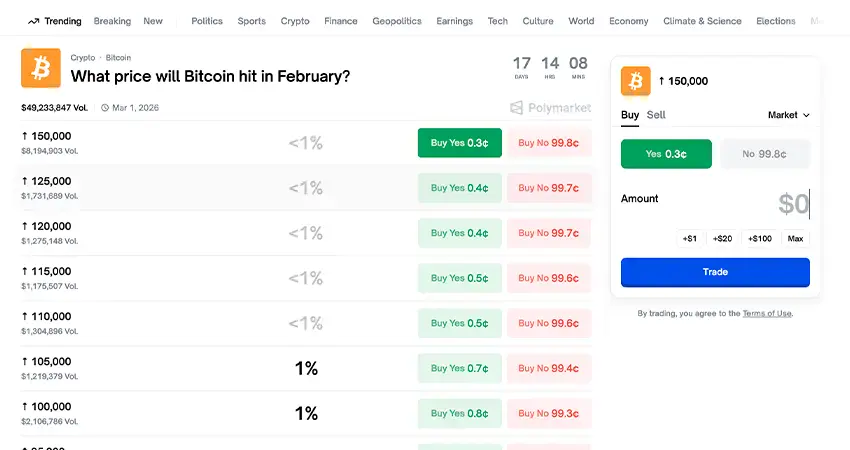
One of the most important concepts to understand is how prediction market prices translate into probabilities. Unlike sportsbook odds, prediction market prices already represent a percentage-based estimate of an outcome happening.
In most markets, contracts are priced between $0 and $1. The price reflects what traders collectively believe the outcome is worth at that moment. A contract trading at $0.25 suggests the market thinks there is roughly a 25 percent chance the event occurs. A price of $0.80 suggests an 80 percent chance.
This interpretation works because of how payouts are structured. Since a winning contract pays out $1 and a losing contract pays $0, traders are only willing to pay what they believe that future $1 payout is realistically worth. As opinions change, prices adjust to reflect new probability estimates.
It is important to remember that these probabilities are not guarantees. They are market opinions, not final outcomes. Prices can be wrong, slow to update, or influenced by emotion, headlines, or one-sided trading. In low-liquidity markets, prices may reflect the view of only a handful of traders rather than broad consensus.
We treat prediction market prices as signals, not truth. Skilled users compare the market’s implied probability with their own estimate. When there is a meaningful gap between the two, that is where potential opportunity exists.
Implied Probability Explained
A contract priced at $0.30 implies a 30 percent chance the outcome occurs. A contract priced at $0.75 implies a 75 percent chance. This works because no rational trader would pay more than they believe the outcome is worth at settlement.
Prices move as traders update their beliefs. When confidence rises, buyers are willing to pay more. When confidence drops, sellers accept lower prices.
Why Prices Change Over Time?
Prediction market prices are not fixed. They change as new information becomes available, such as polls, data releases, official statements, or unexpected news.
In active markets, prices can update within seconds. In quieter markets, prices may lag behind reality or jump suddenly when a single trader places a large order. This is why price movement alone does not always mean accuracy.
When Prices Can Be Misleading?
Not all prices reflect true probabilities. In low-liquidity markets, prices may represent the opinion of only a few traders. Emotional trading, hype, or one-sided participation can also distort prices.
We often see this in niche or novelty markets, where enthusiasm outweighs careful probability assessment. A high price does not always mean high confidence across the market.
Liquidity & Market Depth (Why They Matter)
Liquidity determines how easily you can buy or sell contracts without significantly moving the price. Market depth refers to how many orders are available at each price level in the order book. A contract may look mispriced, but if there is not enough volume behind it, you may not be able to enter or exit at the displayed price.
In thin markets, prices can shift sharply based on small trades, which can distort implied probabilities. Key things to check before trading include:
- Bid–ask spread: A tight spread like $0.59 / $0.60 is efficient; a wide spread like $0.51 / $0.60 creates friction.
- Order book depth: Large visible volume at one price signals stability.
- Recent trading activity: Active markets are easier to exit before resolution.
Liquidity does not determine whether you are right about an outcome, but it determines whether you can trade that view efficiently.
Risks of Prediction Markets
Prediction markets can be useful forecasting tools, but they also come with risks that are easy to overlook, especially for new users. Understanding these downsides is just as important as understanding how pricing works.
Low Liquidity Risk
Low liquidity is the most common issue in prediction markets. When few traders are active, prices can move sharply based on small trades. This can make probabilities look misleading and make it difficult to exit a position without taking a loss.
In thin markets, you may be correct about the outcome but still struggle to sell your contracts at a fair price before resolution. Funds can remain locked longer than expected, especially if interest in the market fades.
Mispricing and Timing Risk
Prediction markets do not always update instantly or accurately. Prices can lag behind real-world developments or overreact to incomplete information. Early traders, loud narratives, or coordinated buying can temporarily push prices far away from realistic probabilities.
Timing matters. Being right too early or too late can still result in losses if prices move against you before resolution.
Platform and Regulatory Risk
Platform risk varies widely. Centralized prediction markets rely on the operator to manage funds, resolve outcomes correctly, and process withdrawals. Decentralized and crypto prediction markets reduce reliance on operators, but introduce smart contract risk, oracle failures, and network-related issues.
Regulatory risk is also real. Market availability, event types, or user access can change with little notice depending on jurisdiction. This can affect whether you can trade, withdraw, or access certain markets.
Prediction markets reward careful users who understand these risks and size their positions accordingly. They are not designed for casual or impulse betting.
Are Prediction Markets Legal in the US?
The legality of prediction markets in the United States depends on how the platform is structured. Some centralized platforms operate under federal oversight as event-based derivatives, typically regulated by the Commodity Futures Trading Commission. These platforms follow compliance requirements such as identity verification, approved market listings, and defined settlement rules.
Other platforms operate offshore or through decentralized crypto protocols, where regulatory clarity is less straightforward. Access does not always mean full legal certainty, and availability can change depending on federal oversight, platform policy, or state-level guidance. Before depositing funds, users should verify whether the platform permits US customers and review its regulatory disclosures and terms of service.
Prediction Market FAQ
Find answers to common questions bettors like you have when researching which sportsbook to join.
Legality depends on the platform, market structure, and regulatory approval. Some platforms operate under specific exemptions or licenses, while others restrict US users or limit market types. Always check a platform’s terms before trading.
Prediction market software is the system that handles market creation, order matching, pricing, settlement, and user balances. It can be centralized, run by a single operator, or decentralized, using blockchain-based smart contracts.
Crypto prediction markets use cryptocurrencies instead of fiat currency and typically rely on blockchain infrastructure. Settlement is often automated, but users take on added risks related to smart contracts, network fees, and data oracles.
In most standard prediction markets, losses are limited to the amount paid for contracts. You cannot lose more than your upfront cost. Some advanced contract types behave differently, so it is important to understand payout rules before trading.
Prediction markets and sports betting serve different purposes. Prediction markets suit users who want to trade probabilities and react to information over time. Sports betting suits users who prefer fixed odds, bonuses, and familiar bet types. For a detailed comparison, see our prediction markets vs sports betting guide.

Chris Wassel is a veteran sports writer, editor, and betting analyst with nearly three decades of experience covering sports, fantasy sports, and wagering. A longtime member of the Fantasy Sports Writers Association (FSWA), the Fantasy Sports & Gaming Association (FSGA), and several sports betting communities, Chris has built a reputation for combining d...
Read More About the Author