Prediction Markets vs Sports Betting | Key Differences, Pros & Cons
 by
Chris Wassel
by
Chris Wassel
Prediction markets and sports betting both allow users to bet on real-world events, but they operate through different structures. Users can participate through dedicated prediction market platforms, where contracts trade based on perceived probabilities, or through sportsbooks, including offshore sports betting sites, where odds are set by the operator.
Understanding how these systems differ is important before choosing where to place a wager. While both involve predicting outcomes, the mechanics behind pricing, risk management, liquidity, and regulation vary significantly.
Prediction Markets vs Sports Betting: At a Glance
Before getting into detailed explanations, it helps to see how prediction markets and sports betting differ at a structural level. While both involve predicting outcomes, the way prices are set, risks are managed, and markets operate is fundamentally different.
| Category |
Prediction Markets |
Sports Betting (Including Offshore Sportsbooks) |
|---|---|---|
How prices are set |
Prices are set by users through buying and selling contracts. Market demand determines value. | Odds are set by the bookmaker, with a built-in vig. |
Pricing format |
Contract prices between $0 and $1 that imply probability. | Odds formats such as moneylines, spreads, and totals. |
Who you trade against |
Other users participating in the market. | The sportsbook itself. |
Ability to exit early |
Positions can usually be sold before resolution if liquidity exists. | Bets are typically locked in, with limited or no cashout options. |
Markets offered |
Politics, economics, crypto, niche events, and some sports-related markets. | Primarily sports, with some entertainment or novelty markets depending on location. |
Liquidity model |
Depends on user participation and market depth. | The bookmaker absorbs risk and manages exposure. |
Regulatory structure |
Varies by platform and market type, often limited or specialized. | Regulated sportsbooks or offshore operators, depending on jurisdiction. |
Risk profile |
Market risk, liquidity risk, and platform risk. | Odds risk, betting limits, and bookmaker rules. |
Best suited for |
Users interested in trading probabilities over time. | Users who prefer fixed wagers and traditional bet types. |
What Are Prediction Markets?
Prediction markets are platforms where users trade contracts tied to the outcome of future events. Instead of placing a fixed wager, users buy and sell contracts whose prices reflect how likely the market believes an outcome is to occur. A contract typically settles at $1 if the event happens and $0 if it does not.
The key difference is price formation. Prediction markets do not set odds or apply a bookmaker margin. Prices move based on supply and demand as traders react to new information. When confidence in an outcome increases, prices rise. When confidence drops, prices fall.
If you want a deeper breakdown of how contracts, pricing, and settlement work, see our full guide on how prediction markets work. For platform comparisons, our best prediction market sites page covers where these markets are available and how they differ.
What Is Sports Betting (Including Offshore Sportsbooks)?
Sports betting involves placing a wager with a sportsbook at fixed odds. The sportsbook sets those odds, builds in a margin known as the vig, and accepts the risk of the bet. Common bet types include moneylines, point spreads, totals, and futures.
In the United States, sports betting availability depends on state law. Many bettors also use offshore sportsbooks, which operate outside the US but still accept American players. These sites often offer broader markets and fewer restrictions, though they come with different regulatory considerations.
Unlike prediction markets, sports bets are usually locked in once placed. Some sportsbooks offer cashout features, but these are optional and controlled by the bookmaker.
For a full breakdown of betting formats and availability, see our guides to sports betting sites and offshore sportsbooks.
Key Differences Between Prediction Markets and Sports Betting
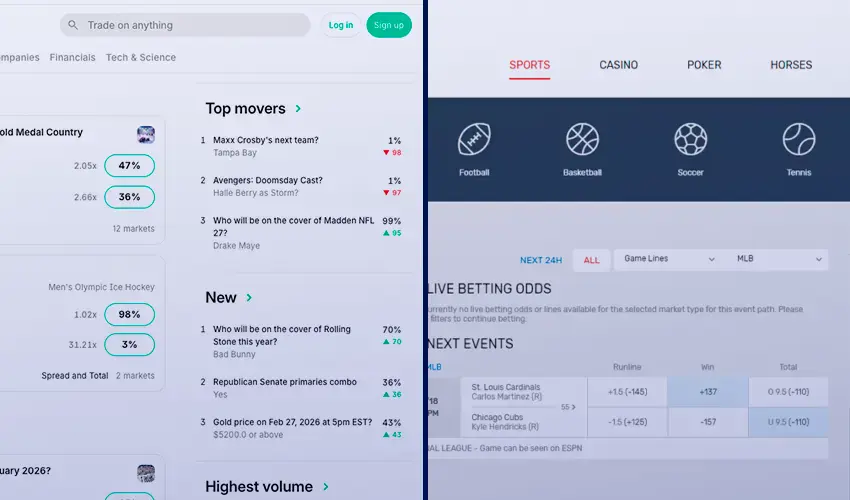
While prediction markets and sports betting both revolve around predicting outcomes, they operate in fundamentally different ways. These differences affect how prices are formed, how users interact with markets, what events are available, and how regulation applies.
Pros and Cons of Prediction Markets vs Sports Betting
Both prediction markets and sports betting have clear strengths and trade-offs. Neither model is objectively better. The right choice depends on what you want out of the experience and how comfortable you are with different types of risk.
Which Is Right for You?
Choosing between prediction markets and sports betting depends less on which model is “better” and more on what you are trying to achieve.
If your goal is to trade probabilities over time, prediction markets may be a better fit. They work best for users who enjoy reacting to new information, managing positions actively, and thinking in terms of percentages rather than odds. Prediction markets also appeal to people interested in events beyond sports, such as politics, economics, or crypto-related outcomes.
If your goal is straightforward wagering with clear payouts, sports betting is usually the better option. Sportsbooks are easier to use, markets are more liquid, and bet types are familiar. Offshore sportsbooks can also appeal to US bettors who want access to more markets, higher limits, or fewer restrictions, as long as they understand the trade-offs involved.
Many experienced users do not choose one or the other exclusively. They use sports betting for traditional games and futures, and prediction markets for niche events or situations where market pricing feels more efficient. Understanding how each model works makes it easier to decide when each approach makes sense.
Disclaimer |
| This page is for informational purposes only. It does not constitute legal, financial, or betting advice. Laws, regulations, and platform availability vary by location, and users are responsible for understanding the rules that apply to them before participating in prediction markets or sports betting. |
Prediction Markets vs Sports Betting FAQ
Find answers to common questions about prediction markets vs sports betting sites.
Legality depends on the platform and the type of market offered. Some prediction markets operate under specific regulatory approvals or exemptions, while others restrict access for US users. Availability can change based on regulatory decisions, so it is important to review a platform’s terms before trading.
Prediction markets sit in a gray area. They are often structured as event-based trading rather than traditional gambling, which is why they can offer markets sportsbooks cannot. That distinction does not remove risk, and it does not guarantee availability in every jurisdiction.
Some prediction markets offer sports-related markets, but coverage is usually limited compared to sportsbooks. These markets often focus on futures, season outcomes, or high-level events rather than individual games or player props.
No. Prediction markets use prices instead of odds. A contract price reflects the market’s implied probability of an outcome occurring, while sportsbook odds are set by a bookmaker and include a built-in margin.
Yes. Many users use both depending on the event. Sports betting is usually better for traditional games and standardized markets, while prediction markets can be useful for niche events or situations where trading flexibility matters.

Chris Wassel is a veteran sports writer, editor, and betting analyst with nearly three decades of experience covering sports, fantasy sports, and wagering. A longtime member of the Fantasy Sports Writers Association (FSWA), the Fantasy Sports & Gaming Association (FSGA), and several sports betting communities, Chris has built a reputation for combining d...
Read More About the Author