Kalshi Review: Markets, Regulation, and How It Works
 by
by
SUMMARY
- What Is Kalshi?
- Background and History of Kalshi
- How Kalshi Betting Works
- Kalshi Odds Explained
- Markets Covered: Politics, Economic Events, and Headline Contracts
- Kalshi Fees
- Trading Limits
- Deposits and Withdrawals
- Kalshi Promo Code
- Is Kalshi Legit?
- Safety, Track Record, and Reputation
- Customer Support
- User Experience and Platform Design
- Mobile Access
- Geography, KYC, and Accessibility
- Who Is Kalshi Best For?
- Alternatives to Kalshi
- Final Verdict on Kalshi
- How We Evaluated Kalshi
Quick take: This Kalshi review explains how this regulated prediction market works, what Kalshi markets you can trade, how Kalshi election odds are priced, what fees to expect, and what to know when readers ask questions like “what is Kalshi?” or “is Kalshi legit?”
Rating: 4.3/5
Best for: Traders who want event contracts on politics, economics, and headline-driven markets, including Kalshi election markets and contracts tied to major news events such as a Kalshi government shutdown market.
Not ideal for: Bettors who prefer traditional sportsbook options like spreads, totals, parlays, and large welcome bonuses.
Pros
- Exchange model that prices contracts by implied probability rather than fixed sportsbook odds
- Strong coverage of politics, economics, and headline-driven Kalshi prediction market contracts
- Ability to trade in and out of positions before an event settles
Cons
- Event contract format feels different from standard sportsbook betting
- Liquidity can vary across Kalshi markets, which affects entry and exit prices
- Kalshi betting is more appealing to traders than to casual sports bettors
Kalshi is a US-regulated prediction market exchange where users trade on the outcome of real-world events. During major political and economic news cycles, Kalshi markets can move quickly as traders react to fresh information.
This Kalshi review explains how Kalshi betting works, how Kalshi election odds translate into implied probability, what Kalshi fees you actually pay, whether a Kalshi promo code exists, and what to know before deciding whether Kalshi is legit for your style of trading.
What Is Kalshi?
If you are wondering what Kalshi is, the platform can best be described as a regulated prediction market exchange where users trade contracts based on the outcome of real-world events. Instead of placing a fixed-odds bet like you would at a traditional sportsbook, traders buy and sell event contracts tied to specific questions.
Each contract typically trades between $0.00 and $1.00. For example, if a “Yes” contract is trading at $0.65, the market is implying a 65 percent chance that the event will occur. If the event resolves as “Yes,” the contract settles at $1.00. If the outcome is “No,” it settles at $0.00.
This structure makes Kalshi betting feel closer to trading than sportsbook wagering. Prices move based on supply and demand as traders react to new information. Instead of a bookmaker setting lines and building in a vig, the market determines the price of each contract.
The result is a prediction market where traders can express views on real-world outcomes such as elections, economic reports, or political developments. As new information enters the market, Kalshi markets adjust in real-time, allowing traders to buy or sell positions before the final result is known.
Background and History of Kalshi
Kalshi was founded in 2018 and later launched its exchange. The company was founded by Tarek Mansour and Luana Lopes Lara, who built the platform with the goal of creating a transparent exchange for event-based contracts.

Kalshi Inc operates as a designated contract market regulated by the US Commodity Futures Trading Commission (CFTC). This regulatory status is one of the main differences between the Kalshi prediction market and many crypto-based prediction platforms, which often operate outside formal regulatory frameworks.
The idea behind Kalshi is to allow traders to hedge risk or express views about real-world events using simple binary contracts. These contracts ask clear questions such as whether inflation will exceed a certain level, whether a government shutdown will occur, or whether a specific political outcome will happen.
Since launch, Kalshi markets have expanded to include political contracts, economic indicators, weather events, and other measurable outcomes. Kalshi election markets have received particular attention during US election cycles because traders watch Kalshi election odds as a real-time reflection of market sentiment.
Kalshi raised a $30M Series A led by Sequoia Capital. The company has positioned itself as a regulated alternative to traditional prediction markets, emphasizing compliance, transparency, and a structured exchange model.
Kalshi is a CFTC-regulated Designated Contract Market (DCM), which allows it to list event contracts in the United States under federal oversight. However, its regulatory position is still evolving, with ongoing disputes at the state level and recent legal developments highlighting that its availability and operations are not entirely free from jurisdictional challenges.
How Kalshi Betting Works
Kalshi Odds Explained
Kalshi odds are displayed as prices rather than traditional American odds like -110 or +200. Contracts typically trade from $0.01 to $0.99 in $0.01 increments and settle at $1 if the event occurs.
For example, if a Yes contract is trading at $0.72, the market is implying a 72 percent chance that the event will occur. If the contract resolves as Yes, each share settles at $1.00. If the outcome is No, the contract settles at $0.00.
This structure makes Kalshi markets easy to interpret once you understand that price equals probability. Traders simply read the contract price as a percentage likelihood assigned by the market.
| $0.80 price = 80 percent implied probability
$0.50 price = 50 percent implied probability $0.20 price = 20 percent implied probability |
Because Kalshi operates as an exchange, prices move as traders react to new information. Major announcements, economic data releases, and political developments can all cause contracts to shift quickly.
During election cycles, Kalshi election markets often move within minutes of new polling results, debates, or campaign news. Many traders follow Kalshi election odds alongside traditional political forecasting models because the prices reflect real money positions taken by market participants.
This real-time adjustment is one reason prediction markets like Kalshi are often viewed as indicators of public sentiment. As new data enters the market, traders adjust their positions and the contract prices update immediately.
Markets Covered: Politics, Economic Events, and Headline Contracts
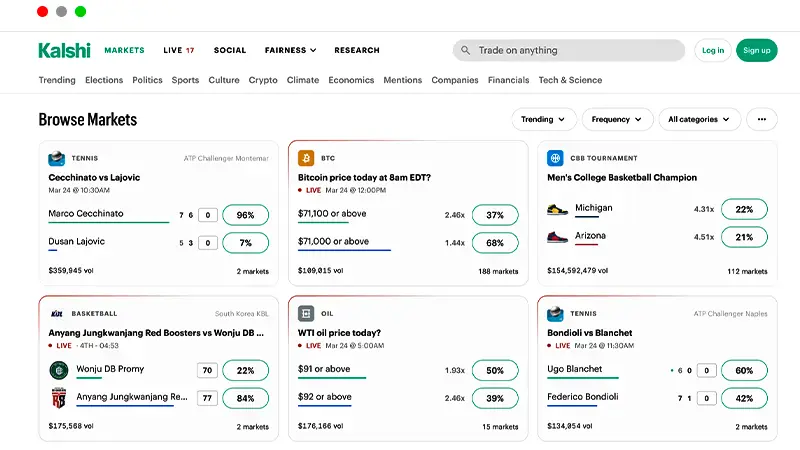
Kalshi markets focus on real-world events that can be measured with clear data sources. The platform offers contracts tied to politics, economic indicators, weather outcomes, and major news developments. While the selection is different from a sportsbook, the Kalshi prediction market still provides a wide range of topics for traders who follow global events closely.
Most Kalshi markets revolve around a simple question format, where traders buy or sell Yes and No contracts depending on how they expect the event to resolve. Kalshi also lists event markets related to sports outcomes and milestones, though they differ from traditional sportsbook bets like spreads or totals.
Political and Election Markets
Political markets are among the most visible contracts on the platform. During election cycles, trading activity increases as participants react to polling data, campaign developments, and major political announcements.
Kalshi election markets often track questions related to election outcomes, party control of government bodies, or specific political events. Because the prices move in real-time, Kalshi election odds provide a snapshot of how traders currently assess the chances of a political outcome.
Common examples include contracts related to:
- US presidential election outcomes
- Party control of the House or Senate
- Candidate nomination results
- Major political developments tied to national elections
For example, a contract might ask whether a particular candidate will win the next election. If the Yes contract trades at $0.60, the market is implying roughly a 60 percent probability of that outcome.
Economic and Financial Markets
Economic data releases are another major category on Kalshi. These contracts appeal to traders who follow macroeconomic indicators and government reports.
Typical Kalshi markets in this category include contracts tied to:
- Inflation reports and CPI data
- Unemployment rate releases
- Interest rate decisions
- Economic growth figures
Because these events resolve using official government data, the settlement rules are straightforward. Once the relevant report is released, the contract settles according to the published number.
Sports and Event Outcome Markets
Kalshi also offers sports-related contracts, although they are structured differently from traditional sportsbook bets. Instead of spreads, moneylines, or totals, Kalshi focuses on clearly measurable outcomes tied to events or milestones.
These markets may include:
- Championship winners
- Team or player milestones
- Season-based outcomes
We found that sports markets on Kalshi feel more like event contracts than betting markets. Traders are not wagering on game-by-game performance but on whether a defined outcome will happen by a specific date.
Headline and Event-Based Markets
Kalshi also lists contracts tied to major headline events. These markets are designed to capture outcomes that can be verified through official announcements or widely accepted data sources.
A well-known example is the Kalshi government shutdown market, where traders speculate on whether the US government will shut down during a given time period.
Other contracts may cover weather events, policy decisions, or large public announcements. As with other markets on the exchange, prices update continuously as traders react to new information.
This focus on real-world events is what defines the Kalshi exchange model. Instead of betting on sports scores or player props, traders express views about political outcomes, economic reports, and other measurable developments.
Kalshi Fees
Kalshi fees are structured differently from traditional sportsbook vig. Because Kalshi operates as an exchange, the cost of trading comes from transaction fees and the spread between buy and sell prices rather than a margin built into fixed odds. Kalshi charges a transaction fee based on expected earnings rather than the total trade value.
When using Kalshi betting markets, your total cost typically includes two main components.
- Trading fees charged by the exchange
- The bid-ask spread between market prices
Kalshi applies a transaction fee when trades are executed, with the exact cost depending on potential profit rather than stake size. In practice, this means lower effective fees when trading efficiently in liquid markets. On the funding side, most deposit methods such as ACH, PayPal, Venmo, and bank transfers do not carry processing fees, while debit card deposits typically include a fee of around 2 percent.
Because the platform functions as a prediction market exchange, prices are determined by traders placing orders. In active markets such as Kalshi election contracts or major economic reports, the bid-ask spread is usually narrow. In smaller markets with fewer participants, spreads can widen and increase the effective cost of entering or exiting a position.
Kalshi does not build a bookmaker margin directly into the contract price. Instead, traders interact with each other in the market and the exchange collects a transparent fee on completed trades.
Before entering larger positions, it is always worth reviewing the current order book. Liquidity and spreads can vary significantly across different Kalshi markets.
Trading Limits
Kalshi does not operate with traditional sportsbook-style betting limits. Instead, the size of your position depends on market liquidity and how many contracts are available in the order book.
In highly active markets such as Kalshi election contracts or widely followed economic indicators, traders can often enter larger positions because there are more buyers and sellers participating in the market.
Smaller Kalshi markets may have thinner liquidity. In those cases, attempting to buy or sell a large number of contracts can move the market price significantly before the order is fully filled.
This exchange model means traders must pay attention to the order book before entering a position. The available liquidity determines how easily you can open or close a trade without impacting the price.
Unlike traditional betting platforms that set fixed limits, Kalshi markets scale naturally with demand. As more traders participate in a contract, the depth of the market usually increases and larger trades become easier to execute.
Deposits and Withdrawals
Deposits and withdrawals follow a brokerage-style process rather than a betting wallet system. While the platform previously focused on bank transfers, it now supports a wider range of payment methods.
Kalshi operates exclusively in US dollars, and all trades, deposits, and withdrawals are processed in USD. The platform does not support holding balances in other fiat currencies, although some funding methods may involve conversion before reaching your account.
To deposit funds, users can connect a bank account or use supported payment methods such as ACH transfers, debit cards, PayPal, Venmo, Cash App, crypto transfers, or wire deposits. In our experience, availability can vary depending on location and account status, with some options limited for international users. Once the deposit is confirmed, the balance becomes available for trading in Kalshi markets.
Withdrawals follow a similar structure, with funds typically returned through bank transfers or other supported payout methods. Processing times depend on the method used, but most follow standard financial clearing timelines.
Because Kalshi is a regulated exchange, identity verification is required before funding or withdrawing. This process helps the platform comply with financial regulations and maintain the integrity of the Kalshi prediction market.
Compared with crypto-based prediction platforms, this setup still feels closer to using a traditional financial account, although the expanded payment options make it more flexible than a strictly bank-only system.
Kalshi Promo Code
Kalshi occasionally offers referral bonuses, and according to its official referral FAQ, the current program provides $25 to the referrer and $25 to the referred user, subject to specific requirements. This is notably higher than older or informal estimates and reflects the platform’s updated incentive structure.
Many users searching for a Kalshi promo code expect a traditional sportsbook-style welcome bonus, which is not how the platform operates. Because Kalshi functions as a regulated prediction market exchange, it generally does not provide large deposit match bonuses. Instead, promotions tend to focus on trading-related incentives such as temporary fee reductions, rewards tied to specific markets, or limited campaigns around major events.
The platform places greater emphasis on pricing efficiency and market liquidity than on bonus-driven betting activity. Most users choose Kalshi for its regulated structure and event contract markets rather than promotional offers.
If a referral bonus or limited promotion is available, it will typically appear directly on the platform during periods of high activity, such as election cycles or major economic announcements. Users primarily interested in large signup bonuses will usually find more aggressive promotions at traditional sportsbooks rather than prediction market exchanges like Kalshi.
Is Kalshi Legit?
Many new users ask whether Kalshi is legit before trading on the platform. Kalshi operates as a regulated prediction market exchange and is overseen by the US Commodity Futures Trading Commission (CFTC). This regulatory approval makes it different from many other prediction markets that operate outside formal financial oversight.
Kalshi Inc is registered as a designated contract market, which means it can legally list and settle event-based contracts under US regulatory supervision. These contracts must follow strict rules regarding transparency, settlement criteria, and market integrity.
Each Kalshi prediction market resolves based on publicly verifiable data sources. For example, economic markets settle using official government reports, while election markets rely on certified election results. This structured settlement process is designed to ensure fairness and prevent disputes over outcomes.
The platform also requires identity verification before users can trade. This process helps the exchange meet financial compliance standards and maintain a regulated trading environment.
Because of this regulatory structure, many traders consider Kalshi one of the most legitimate event trading platforms available. However, like any market exchange, the value of contracts can fluctuate, and traders still take on financial risk when entering positions.
Safety, Track Record, and Reputation
Kalshi has built a reputation as one of the most structured and transparent prediction market platforms operating today. Unlike many event trading platforms, Kalshi functions within a regulated financial framework overseen by the US Commodity Futures Trading Commission (CFTC).
This regulatory oversight requires Kalshi to follow strict rules related to market integrity, contract design, and settlement procedures. Each Kalshi market must define a clear event question and an objective data source used to determine the final result.
From a security standpoint, the platform operates similarly to a financial exchange. Funds are held within regulated systems rather than through decentralized crypto wallets, and users must complete identity verification before trading.
The company behind the platform, Kalshi Inc, has raised funding from venture investors and has continued to expand its event contract offerings. Leadership from founders including Tarek Mansour has positioned the exchange as a regulated alternative to many crypto-based prediction markets.
That said, Kalshi trading still carries market risk. Contract prices move based on trader expectations, which means positions can gain or lose value quickly when new information enters the market.
Overall, Kalshi reviews from traders tend to highlight the platform’s regulatory status, structured market design, and transparent contract settlement rules as major strengths. The main limitations typically relate to liquidity in smaller markets and the learning curve for users unfamiliar with event-based trading.
Customer Support
Kalshi provides customer support mainly through online channels rather than a traditional sportsbook-style help desk. Because Kalshi operates as a regulated exchange, its support resources are focused on account setup, trading questions, and contract settlement rules.
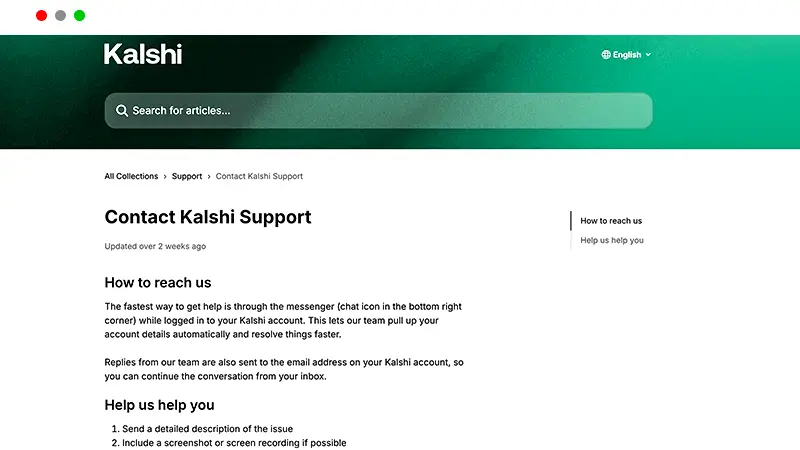
Users can typically reach Kalshi support through:
- The official help center and knowledge base
- Logged-in live chat or messenger support
- Email-based support requests
- Documentation explaining how Kalshi markets and contracts work
The help center includes guides that explain how Kalshi betting works, how contracts settle, and how to navigate the trading interface. Many common questions about deposits, withdrawals, and account verification are covered in these resources.
In our experience, the fastest way to get help is through the logged-in chat or messenger feature. Responses are often delivered directly in the platform and followed up by email. Support requests can still be handled via email tickets, depending on the issue, with response times varying based on volume and complexity.
Because Kalshi operates as a regulated exchange, support cannot reverse trades or modify positions once they are executed in the market. Traders are responsible for reviewing orders carefully before placing them.
User Experience and Platform Design
Kalshi has a clean interface built around trading activity rather than betting. When you open the platform, most markets display price charts, order books, and contract prices that update in real-time.
The layout feels closer to a financial exchange than a betting site. Instead of browsing odds boards or betting slips, users view contracts with Yes and No pricing along with current trading volume and price history.
For traders familiar with probability-based markets, the interface is easy to understand. Contract prices immediately show the market’s implied probability, which removes the need to convert American odds or calculate implied percentages.
During our testing, navigating between Kalshi markets was straightforward. Markets are organized by category such as politics, economic data, and event contracts, which makes it easy to find active trading opportunities.
One adjustment for new users is the order-based trading system. Instead of placing a simple wager, traders must select a contract, choose a price, and submit an order similar to placing a trade on an exchange.
Once users understand the contract format and pricing system, the Kalshi platform becomes intuitive. The design focuses on clarity and data visibility rather than promotional graphics or sportsbook-style betting features.
Mobile Access
Kalshi offers official mobile apps for both iOS and Android, alongside its web-based platform. In our experience, the apps provide a similar interface to the desktop version, with a focus on trading activity.
The mobile experience includes access to Kalshi markets, real-time contract pricing, order books, and price charts. Traders can place and manage positions directly from a smartphone or tablet, with prices updating continuously as market conditions change.
Because the platform is structured as an exchange, the mobile interface feels closer to a financial trading app than a simplified betting app. Users see bid and ask prices, trading volume, and market depth instead of a standard betting slip with fixed odds.
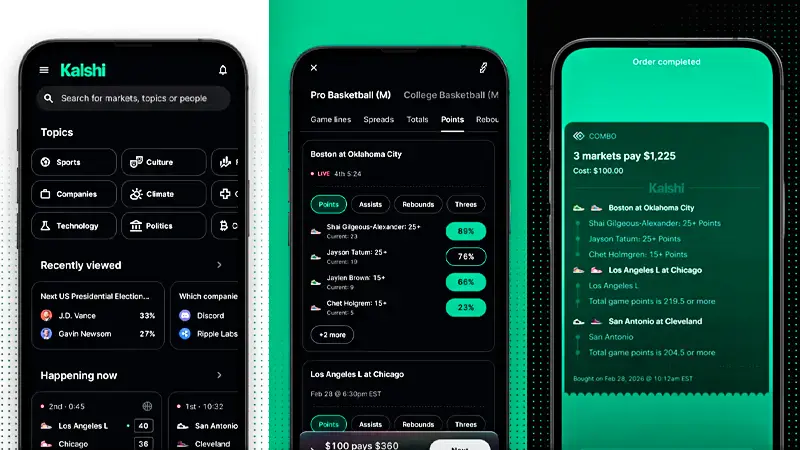
For users familiar with trading platforms, the layout is straightforward and functional. During our testing, navigation between markets was smooth, and the app remained responsive even when prices were moving quickly. However, beginners who expect a quick betting flow may need some time to adjust to the contract-based format.
Overall, the mobile apps deliver a consistent trading experience, though active users may still prefer the desktop version when monitoring multiple markets at once.
Geography, KYC, and Accessibility
Kalshi operates as a US-regulated exchange, but it is not strictly limited to US users. According to official platform guidance, Kalshi is available in multiple countries, although access depends on local regulations and compliance requirements. Some regions may be restricted, and users should expect availability to vary based on their location.
To use the platform, you need to complete identity verification by submitting personal details and a government-issued ID. In our experience, this process feels similar to opening a brokerage account. Kalshi operates exclusively in US dollars, and all trades, deposits, and withdrawals are processed in USD, with no support for holding balances in other fiat currencies.
Who Is Kalshi Best For?
Kalshi is best suited for traders who closely follow politics, economic data, and major news events. The platform’s contract structure allows users to trade probabilities rather than place traditional fixed-odds bets, which makes it different from most sportsbooks and closer to other prediction markets.
Users who are comfortable with exchange-style trading will usually adapt quickly to Kalshi markets. Instead of picking spreads or totals, we see traders buying and selling Yes or No contracts based on how they expect real-world events to unfold.
The platform is particularly appealing to people who actively track political developments, economic indicators, or policy decisions. For example, many users monitor election markets or contracts tied to inflation reports and government announcements, similar to how traders approach platforms covered in our Polymarket review.
Kalshi betting also fits users who prefer regulated trading platforms. Because Kalshi operates under CFTC oversight, the exchange structure may feel more familiar to traders who are used to financial markets than to bettors who mainly use standard online sportsbooks.
However, Kalshi may not be ideal for traditional sports bettors. The platform does not focus on standard betting markets like point spreads, moneylines, or parlays.
Overall, Kalshi works best for traders who want to express views on real-world outcomes through a regulated prediction market rather than a conventional betting platform.
Alternatives to Kalshi
Even though Kalshi is one of the most recognized regulated prediction markets, it is not the only platform where traders can speculate on real-world outcomes. Depending on your location and the type of markets you want to trade, several alternatives may offer different features.
Some platforms focus on crypto-based prediction markets where users trade event contracts using blockchain technology. Others operate with structures similar to financial exchanges but may list different types of markets or offer broader international access.
The main differences between prediction market platforms usually come down to a few key factors:
- Regulatory framework and geographic availability
- Market liquidity and trading volume
- Types of contracts offered, including politics, economics, or crypto-related events
- Fee structure and trading costs
For example, some prediction markets focus heavily on political contracts and election odds, while others emphasize crypto price events, technology announcements, or global macro developments.
If you want to compare multiple platforms, it can help to review a full guide to prediction market sites, along with our Kalshi vs Polymarket and Kalshi vs PredictIt comparisons. Side-by-side comparisons usually highlight differences in fees, liquidity, contract design, and available markets.
Kalshi stands out mainly because it operates as a regulated exchange in the United States. However, traders interested in different market categories or crypto-based trading environments may still consider alternative prediction market platforms.
Final Verdict on Kalshi
This Kalshi review shows that the platform fills a unique role in the prediction market space. Instead of offering traditional sportsbook wagers, Kalshi allows traders to buy and sell contracts tied to real-world events such as elections, economic data releases, and major policy decisions.
Kalshi betting is built around probability-based contracts rather than fixed odds. Each contract reflects the market’s current expectations, and prices move as traders react to new information. This structure allows users to enter or exit positions before an event settles.
One of the biggest advantages of the Kalshi prediction market is its regulatory framework. Because the exchange operates under CFTC oversight, the platform follows clear rules for contract design, settlement procedures, and market transparency.
However, the exchange format may feel unfamiliar to traditional sports bettors. There are no spreads, parlays, or sportsbook-style promotions, and some markets may have limited liquidity compared with larger betting platforms.
For traders who follow politics, economic indicators, and headline-driven events, Kalshi markets can provide an interesting way to trade probabilities in a regulated environment. For users primarily interested in traditional sports betting, a dedicated sportsbook will likely be a better fit.
How We Evaluated Kalshi
For this Kalshi review, we approached the platform the same way we evaluate a new sportsbook or event trading exchange. We created an account, explored active markets, reviewed contract pricing, and observed how prices moved during major news events and economic releases.
Our goal was to understand how the Kalshi prediction market works in practice rather than just reviewing the platform’s marketing claims. We focused on how easy it is for new users to understand contracts, how quickly markets react to new information, and how transparent the pricing structure is.
We focused on five core areas:
- Market depth and liquidity in major Kalshi markets, especially Kalshi election and economic contracts
- How Kalshi odds move when new information enters the market
- Transparency and structure of Kalshi fees
- Ease of use for traders learning how Kalshi betting works
- Clarity around regulation and the common question: is Kalshi legit?
We also compared Kalshi betting mechanics with traditional sportsbooks and other prediction market platforms. This included reviewing how contract prices reflect implied probability and how easy it is to enter or exit a position before settlement.
We also reviewed how clearly the platform explains contract rules, settlement data sources, and trading mechanics.
Frequently Asked Questions
Kalshi FAQs
Kalshi is a regulated prediction market exchange where users trade contracts based on the outcome of real-world events. Each contract trades between $0.00 and $1.00, and the price represents the market’s implied probability of the event occurring.
Kalshi works by listing event contracts that ask a clear question, such as whether inflation will exceed a certain level or whether a political event will occur. Traders buy Yes or No contracts, and the price changes as traders react to new information.
Yes, Kalshi is an exchange overseen by the US Commodity Futures Trading Commission (CFTC). This regulatory status allows the platform to legally list event-based contracts under US financial market rules.
Kalshi does not usually offer traditional sportsbook-style bonuses or large deposit matches. Promotions, when available, typically focus on trading incentives or fee reductions rather than welcome bonuses.
Kalshi markets cover real-world events such as elections, economic reports, government policy decisions, and other measurable outcomes. Prices update in real-time as traders react to new information.
Yes. One of the key features of Kalshi betting is that traders can exit a position before the event resolves. If the contract price moves in your favor, you can sell your position and lock in profit without waiting for the final result.

Luke Chadwik is an experienced writer with a focus on European football, but has always had a keen passion for sport and follows all major leagues across the world. When Luke isn't writing about sports, he's focused on his passion for road biking or spending time with his twin daughters.