Manifold Markets Review: Features, Markets, and Limits
 by
by
Quick take: Manifold Markets stands out for its speed, accessibility, and open market creation system. We’ll explore what kinds of markets you can trade, how Manifold prices probabilities, and how its Mana play-money system compares with separate Sweepcash rewards available in eligible markets. Manifold is available via web and official mobile apps on the Apple App Store and Google Play.
Rating: 4.1/5
Best for: Users who want a fast, low-friction prediction market with community-created questions across politics, tech, sports, culture, and internet trends.
Not ideal for: Bettors who want regulated real-money trading, traditional sportsbook markets, or direct cash withdrawals from standard trading, as cash rewards are limited to Sweepcash in eligible markets and are not tied to typical trading positions.

Pros
- Easy to start using, with free Mana provided to new accounts
- Optional sweepstakes markets with real rewards (eligibility-based)
- Public API and active platform features for users who like to build tools or automate tracking
Cons
- Limited real-money via sweepstakes only
- Market quality and liquidity can vary depending on who created the question
- Less structured than regulated event-contract platforms
Manifold Markets is a social prediction market where users trade on the probability of future events using Mana.
This Manifold Markets review explains how the platform works, how prices reflect implied probability, whether a Manifold promo code exists in any meaningful form, and what to expect before signing up and creating or trading markets.
What Is Manifold Markets?
If you are wondering what Manifold Markets is, it is a social prediction market where users create and trade contracts based on the likelihood of future events.
In addition to Mana, Manifold has introduced sweepstakes-style markets for eligible users. These operate separately from the core play-money system and may allow rewards under specific conditions.
When new users join Manifold, they receive a starting balance of Mana that can be used to trade in prediction markets. These markets ask clear questions about future outcomes. Examples might include whether a political event will occur, whether a company will release a product on time, or whether a sports team will win a championship.
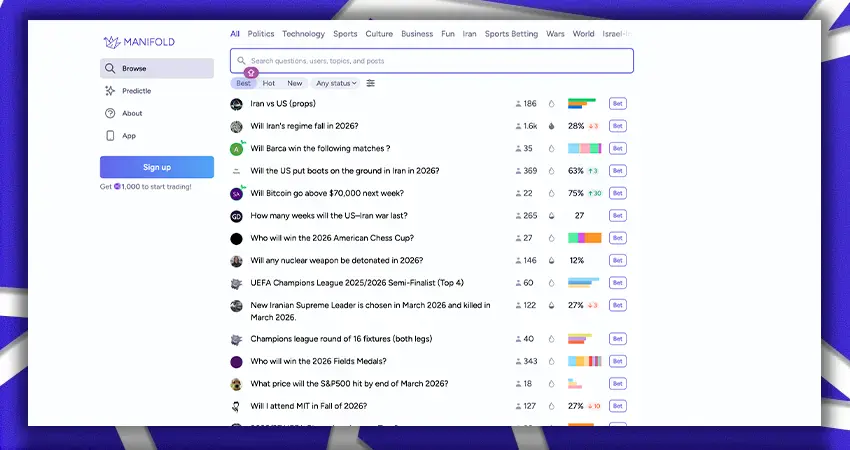
Each market shows a probability rather than traditional sportsbook odds. For example, if a market shows a 70 percent chance of an outcome, it means traders on the platform collectively believe the event is likely to happen.
Manifold Markets allows any user to create a new market as long as the question has clear resolution criteria. Once created, other users can trade on that outcome by buying or selling positions, which moves the probability up or down based on supply and demand.
Many users treat the site as a way to test predictions, explore crowd forecasting, or track how opinions shift as new information appears.
Over time, this model has attracted a community interested in politics, technology, economics, and internet culture. The result is a constantly changing list of markets that reflect what users are currently curious about or debating.
Background and History of Manifold Markets
Manifold Markets was founded in 2021 by Austin Chen, Stephen Grugett, and James Grugett, with early funding from the FTX Future Fund, and operates as a social prediction market where users trade probabilities on future events using a virtual currency called Mana.
New users receive Mana when they sign up, but Mana cannot be converted into cash outside of eligible sweepstakes features. For binary markets, Manifold has said it moved away from its earlier system and now uses a CFMM or CPMM-style market maker that provides continuous liquidity and adjusts probabilities as users trade.
The platform also includes social and developer-focused features such as public user profiles, leaderboards, comment discussions on markets, and a public API that allows developers to build trading bots and analytics tools.
Manifold is mostly accessed through its web platform, which is optimized for mobile devices. The site appeals to forecasting enthusiasts and technology communities who want to experiment with prediction markets.
How Manifold Markets Trading Works
Users trade by buying or selling positions based on whether they think a probability is too low or too high.
When a trader believes an outcome is more likely than the current market probability, they can buy shares in that outcome. If they think the probability is too high, they can sell or bet against it. Manifold uses an automated market maker for continuous trading rather than matching buyers and sellers directly.
Prices move as traders buy and sell positions. If more users believe an event will happen, the probability rises. If traders start selling shares or betting against the outcome, the probability falls.
Each market eventually resolves once the event outcome becomes clear. At that point, the market closes and traders who predicted the correct result receive Mana based on their position size and the price they entered.
One notable feature of Manifold Markets is that traders can exit positions before a market resolves. If the probability changes in their favor, they can sell their shares and lock in gains rather than waiting for the final outcome.
The platform focuses more on forecasting accuracy and community participation than financial profit. Many users treat trading on Manifold as a way to test predictions and see how the crowd evaluates uncertain events.
Manifold Markets Odds Explained
Manifold Markets displays probabilities rather than traditional sportsbook odds. Each market shows a percentage that reflects the crowd’s current belief about how likely an event is to happen.
For example, if a market shows a 70 percent probability that an event will occur, traders on the platform collectively estimate that outcome has a roughly seven-in-ten chance of happening. As users trade shares, that probability moves up or down.
Prices change automatically based on a market-making algorithm that adjusts probabilities as traders buy or sell positions. When more users buy shares in an outcome, the probability rises. When traders sell or bet against that outcome, the probability falls.
- 70 percent probability means the market believes the event is likely to occur
- 50 percent probability indicates the event is viewed as evenly likely or uncertain
- 20 percent probability suggests the crowd believes the outcome is unlikely
Instead of converting odds formats like moneylines or decimals, traders can immediately see the estimated chance of each outcome.
Because probabilities change continuously as traders react to news and new information, Manifold markets often shift quickly when events develop or when users update their predictions.
Over time, these price movements create a visible history of how the community’s expectations evolve as new information enters the market.
Markets Covered: Technology, Politics, Sports, and Internet Culture
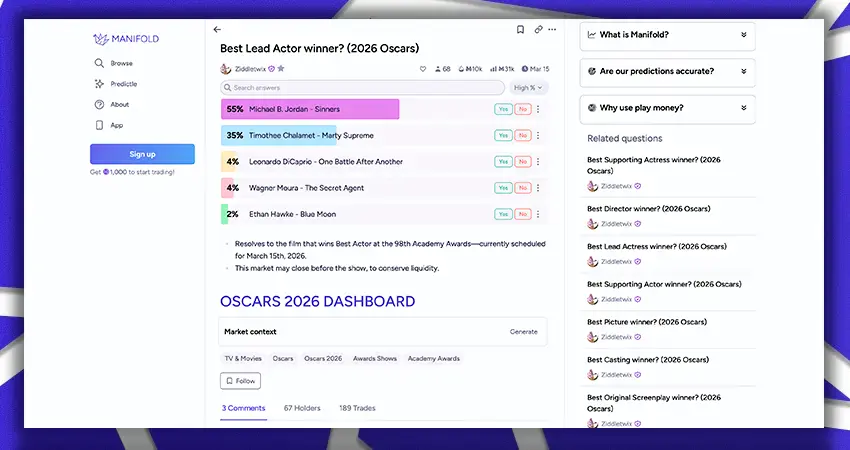
Manifold Markets stands out because almost any user can create a new prediction market. As a result, the platform covers a wide variety of topics rather than focusing on a single category like elections or economic indicators.
Markets are created by the community, which means the list of active questions changes constantly. Some markets last only a few days, while others stay open for months or even years depending on the event being predicted.
Manifold Markets Fees
Manifold Markets does not charge standard trading fees. Instead, prices move through its automated market-making system, with binary markets described by Manifold as using a CFMM or CPMM-style mechanism that builds trading costs into the price curve rather than charging a separate fee.
When users trade on Manifold markets, they buy and sell positions using Mana balances. Trading on Manifold does not involve standard percentage fees, the platform does not charge a percentage fee on each trade the way many financial exchanges or prediction markets do.
Instead, Manifold relies on automated market-making systems to adjust prices as traders enter or exit positions. This system keeps markets liquid and allows probabilities to move smoothly as trading activity changes.
Although normal trading does not involve traditional fees, Manifold may introduce small platform mechanics such as market creation incentives or liquidity adjustments that affect how markets behave. These mechanisms are designed to keep markets active rather than to generate direct trading revenue.
Because the platform uses play-money, traders typically focus more on forecasting accuracy, leaderboard rankings, or community reputation rather than profit after fees.
This structure makes Manifold Markets accessible to new users who want to experiment with prediction markets without depositing real funds or worrying about trading costs.
Trading Limits
Manifold Markets does not use traditional betting limits because the platform runs on virtual currency rather than real-money balances. Instead of restricting wager sizes in the same way sportsbooks or financial exchanges do, trades are limited mainly by the amount of Mana a user holds.
When traders open positions in a market, the size of the trade depends on how much Mana they are willing to commit. Larger trades can move the market probability more significantly because the platform uses an automated market maker to adjust prices.
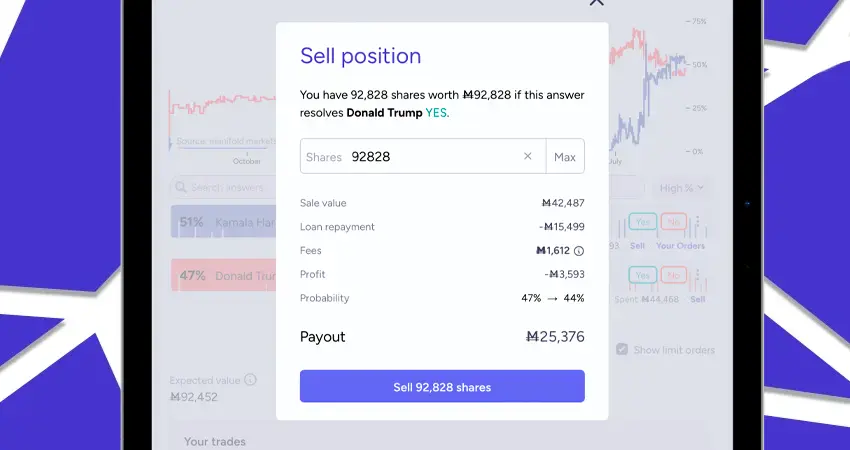
Because markets rely on algorithmic pricing rather than an order book, placing a large trade usually shifts the probability quickly. This means traders must consider how their position will influence the market before committing large amounts of Mana.
Another practical limit comes from liquidity within each market. Markets with many active traders can absorb larger positions with smaller price changes. In smaller markets, even modest trades can move probabilities noticeably.
The purpose of these limits is not risk management for financial exposure. Instead, they help maintain balanced markets and prevent a single trade from dominating the probability too easily.
For most users, the effective limit is simply their Mana balance and the amount they are comfortable committing to a prediction.
Deposits and Withdrawals
Manifold Markets handles deposits, withdrawals, and currencies differently from traditional betting or trading platforms. Instead of a single balance system, the platform separates its core play-money economy from its sweepstakes reward system. Understanding how each currency works is essential before using the platform.
Mana (Primary Trading Currency)
Mana is the main currency used across Manifold Markets. It functions as a virtual balance for trading prediction markets and is not tied to real-money deposits.
When we signed up, we received a starting allocation of Mana immediately, which allowed us to begin trading without funding an account. Mana is earned through successful trades, participation incentives, or periodic platform rewards.
It is important to note that Mana cannot be withdrawn or converted into cash. It is designed purely for forecasting, experimentation, and leaderboard competition.
Sweepcash (Reward-Based Currency)
Separate from Mana, Manifold offers Sweepcash in selected sweepstakes-style markets. This system introduces a limited real-money component, but it operates under specific conditions.
Sweepcash is only available to eligible users, typically those located in approved regions such as most US states. Access requires identity verification before participation or redemption.
Winnings from these markets can be redeemed at a fixed rate of 1.00 Sweepcash to 1.00 USD. The minimum withdrawal is $25, and users must complete identity verification before redeeming rewards. Fees may apply depending on the redemption method and processing conditions, and payout timing can vary rather than following a fixed schedule.
Deposits and Withdrawals Explained
For most users, no deposit is required because standard trading uses Mana. This makes the platform accessible and removes financial risk from everyday trading activity.
Withdrawals only apply to Sweepcash. Users who participate in eligible markets and meet verification requirements can redeem their Sweepcash balance, while Mana remains locked within the platform.
This dual-currency structure separates casual forecasting from reward-based participation. It keeps the core experience simple while offering optional incentives for users who qualify.
Manifold Promo Code
Many users search for a Manifold promo code expecting a traditional bonus similar to what sportsbooks or betting exchanges offer. Manifold Markets works differently because the platform operates with virtual currency instead of real-money deposits.
When new users sign up, they typically receive a starting balance of Mana. This starting balance acts as the platform’s equivalent of a welcome bonus and allows users to begin trading immediately.
Because Manifold does not require deposits, there is usually no need for a promotional code to unlock rewards. Instead, the platform distributes Mana through onboarding bonuses, participation incentives, and occasional platform events.
From time to time, Manifold may run community campaigns or experiments that give users additional Mana for completing certain activities, creating markets, or participating in forecasting challenges.
For most users, the best way to increase their Mana balance is through successful trading. Predicting outcomes correctly and trading efficiently allows users to build larger balances and move up the platform’s leaderboards.
As a result, Manifold Markets focuses more on forecasting skill and community participation than on promotional bonuses or deposit offers.
Is Manifold Markets Legit?
Many users ask whether Manifold Markets is legit before signing up. The platform is a real and active prediction market website where users create and trade markets about future events using a virtual currency called Mana.
Markets resolve based on predefined rules set at creation, using verifiable sources such as official announcements or public data.
However, it also offers sweepstakes-style markets for eligible users, where rewards may be available under specific conditions. These features typically require identity verification and are subject to regional restrictions.
Markets on Manifold resolve according to clearly defined criteria set when the question is created. Market creators or moderators determine the final outcome based on publicly verifiable information, such as official announcements, news reports, or measurable data.
Many users treat the site as a place to test predictions, track probability changes, and participate in forecasting challenges. While Manifold Markets is legitimate as a forecasting platform, it is important to understand that it is not designed for real-money betting.
For users interested in prediction markets, Manifold offers a straightforward and accessible way to explore how probability-based trading works.
Safety, Track Record, and Reputation
Manifold Markets has built a reputation as a community-driven prediction market focused on forecasting and experimentation. Since its launch in 2021, the platform has attracted users interested in politics, technology, science, and internet culture who want to track probabilities for future events.
Manifold operates more like a forecasting game than a traditional betting exchange.
Markets are created and resolved by the community, although moderators and platform administrators can step in if disputes arise. Clear resolution rules are usually written when a market is created so that traders know how the final outcome will be determined.
Over time, the platform has developed an active user base that continuously creates new markets and updates probabilities as events unfold. This activity produces a dynamic environment where predictions change quickly in response to new information.
Moderation and dispute handling are managed by a mix of creators, community input, and platform intervention when needed.
The platform’s reputation is largely built on its active community, open experimentation with prediction markets, and its role as a place where users can practice probability-based forecasting without financial exposure.
Geography, KYC, and Accessibility
Widely accessible for standard Mana-based use, subject to local law. Because the platform primarily uses a virtual currency, users from most countries can sign up and start trading without location-based limitations.
There is no formal KYC or identity verification required for standard Mana-based trading. In our experience, account creation is quick and only requires basic signup details. However, users who want to access sweepstakes-style markets or redeem rewards may need to complete identity verification and meet regional eligibility requirements.
This structure keeps the platform easy to access while introducing additional checks only for users who choose to participate in reward-based features.
Customer Support
Manifold Markets does not offer a traditional customer support system like a sportsbook or regulated exchange. Instead, support is handled through a mix of documentation, community interaction, and direct communication with the team.
The platform includes basic help resources that explain how markets work, how probabilities are calculated, and how trades are placed. Many questions are also addressed within market comment sections, where users discuss rules, outcomes, and trading behavior.
In our experience, the most effective support channel is the Manifold community itself, particularly through Discord, where developers and active users respond to questions and feedback. Users can also contact the team directly for technical issues or platform-related concerns.
Support is primarily focused on usability and market mechanics, although assistance is also available for account-related and Sweepcash issues through official support channels.
User Experience and Platform Design
Manifold Markets has a clean interface designed around quick prediction trading rather than complex financial charts. When users open the platform, markets appear as simple questions with a probability percentage showing how likely the community believes the event is to occur.
The homepage highlights trending markets, recently created questions, and markets with the most trading activity. This layout helps users quickly find active predictions without needing to navigate complicated menus.
Each market page shows the current probability, trading history, and recent activity from other traders. Users can buy or sell shares directly from the market interface, which updates the probability immediately after each trade.
Key interface elements include:
- Trending markets and newly created predictions shown on the homepage
- Real-time probability updates as trades occur
- Market pages displaying price history and recent trading activity
- Quick buy and sell controls for placing trades in seconds
- Comment sections where users discuss predictions and explain reasoning
- User profiles and leaderboards tracking forecasting performance
Compared with traditional prediction exchanges, the platform focuses on speed and simplicity. Traders can move between markets quickly, place trades in seconds, and watch probabilities change as new information enters the market.
The social element of the platform is also visible in the design. Users can comment on markets, discuss outcomes, and explain their reasoning for trades. These conversations often help traders understand why probabilities are moving.
Mobile Access
Manifold Markets is available through its web platform and supported mobile applications, including distribution through app stores. Users can access markets, place trades, and track probabilities on both desktop and mobile devices.
The mobile experience closely mirrors the desktop interface. Markets appear as simple questions with probability percentages, and users can quickly buy or sell positions using their Mana balance.
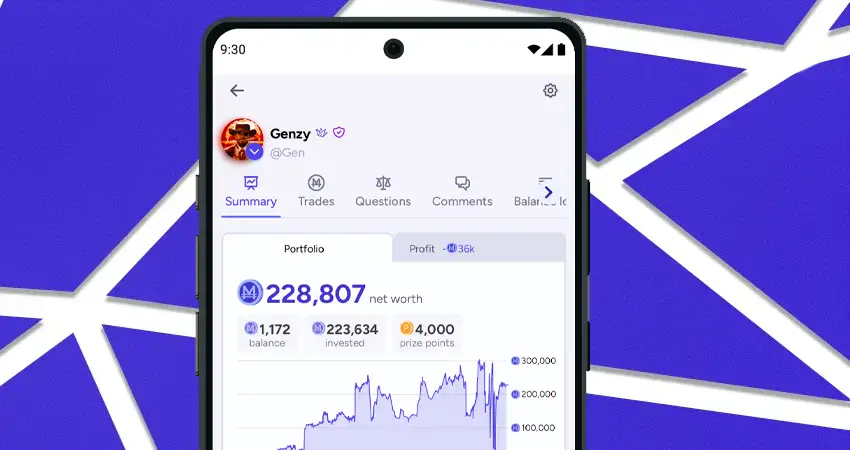
The interface is designed to load quickly on smaller screens, making it easy to check active markets or respond to breaking news events that might influence predictions.
Because the platform focuses on speed and accessibility, most core features are available on mobile. Traders can create markets, comment on predictions, and view trading history directly from their device.
Active users who follow multiple markets may still prefer the desktop layout for easier navigation between predictions. However, the mobile version works well for monitoring probabilities and placing quick trades.
Who Is Manifold Markets Best For?
Manifold Markets is best suited for users that enjoy forecasting future events who want a low-risk prediction market experience. Because the platform runs on Mana, it appeals to people who want to trade probabilities for fun, practice, or reputation rather than financial profit.
The platform is particularly popular with forecasting enthusiasts who enjoy testing predictions against the crowd, tech and AI communities that frequently create markets about new tools, releases, and industry developments, and users experimenting with prediction markets who want to learn how probability trading works.
However, Manifold may not be ideal for users who want regulated real-money trading or traditional sportsbook markets. Those looking for cash payouts, large betting limits, or standard wagering formats will usually prefer platforms designed for real-money event contracts.
Alternatives to Manifold Markets
Although Manifold Markets is one of the most active community-driven prediction platforms, it is not the only place where users can trade forecasts on future events. Several other prediction markets offer different structures, trading mechanics, and levels of regulation.
Some platforms focus on regulated event contracts and real-money trading, while others operate with crypto-based markets or research-focused political forecasting systems. The main differences between these platforms usually come down to a few key factors:
- Whether the platform supports real-money trading or play-money markets
- The types of markets available, such as politics, economics, technology, or sports
- Market liquidity and the number of active traders
- Fee structures and trading mechanics
For example, some prediction markets concentrate on political forecasting, while others focus on economic indicators or broader global events. Platforms that support real-money contracts often operate under regulatory oversight, while community-focused platforms prioritize accessibility and experimentation.
Manifold Markets stands out because of its open market creation system and social features. However, users who want real-money trading, more structured contract rules, or higher liquidity may prefer other prediction market exchanges.
If you want to compare platforms in more detail, reviewing a broader guide to prediction market sites can help highlight differences in market types, trading systems, and user experience. Users who want a real-money crypto-based alternative can also compare the experience in our Polymarket review.
Final Verdict on Manifold Markets
This Manifold Markets review shows that the platform fills a different role from most traditional prediction markets. Manifold is designed as a social forecasting platform where users trade probabilities.
The platform’s biggest strength is accessibility. New users can start trading immediately without deposits, and the wide variety of community-created markets keeps the experience fresh and unpredictable.
Manifold also stands out because of its active community and open market creation system. Users can launch their own questions, discuss predictions, and watch probabilities change as traders react to new information.
However, the play-money structure also means the platform is not ideal for users looking for real financial exposure. Traders who want regulated event contracts or large betting limits will likely prefer platforms built for real-money markets.
For people interested in forecasting, experimenting with probability-based markets, or participating in an active prediction community, Manifold Markets offers an engaging environment.
If your goal is to learn how prediction markets work or test your forecasting skill against other users, Manifold provides one of the easiest ways to start.
How We Evaluated Manifold Markets
For this Manifold Markets review, we approached the platform the same way we would evaluate any prediction market platform. We created an account, explored active markets, and tested how trading works using the platform’s Mana currency.
Our goal was to understand how the platform functions in real use rather than relying only on feature descriptions. We focused on how easy it is for new users to start trading, how quickly markets update, and how active the community is.
We focused on five core areas:
- Market variety and the range of topics covered on the platform
- How Manifold probabilities move as traders buy and sell positions
- Ease of use for new users learning how prediction markets work
- Community activity, including user-created markets and discussions
- Overall accessibility compared with real-money prediction exchanges
We also compared Manifold Markets with other prediction platforms to see how its play-money model affects liquidity, trading behavior, and the overall forecasting experience.
Because Manifold focuses on community forecasting rather than financial trading, we also evaluated how well the platform supports experimentation, discussion, and crowd prediction.
Frequently Asked Questions
Manifold Markets FAQs
Manifold Markets is a prediction market platform where users trade on the probability of future events using a virtual currency called Mana. Markets are created by the community and cover topics ranging from politics and technology to sports and internet culture.
Manifold Markets is primarily a play-money platform that uses a virtual currency called Mana for most markets. However, it also offers selected sweepstakes-style markets for eligible users in certain regions, such as the United States. These markets use a separate system, often referred to as Sweepcash, where users who meet eligibility requirements and complete identity verification (KYC) may be able to redeem winnings, subject to platform rules and fees.
Manifold typically does not require promo codes because new users automatically receive a starting balance of Mana when they create an account.
Markets resolve when the outcome of the question becomes clear. The result is determined using publicly verifiable information based on the rules defined when the market was created.
Yes. One of the main features of Manifold Markets is that users can create their own prediction markets as long as the question has clear resolution criteria.
Manifold Markets is available through its website and can also be accessed via a mobile application. The platform is designed to work smoothly on both desktop and mobile devices, allowing users to browse markets, place trades, and track probabilities on the go.

Luke Chadwik is an experienced writer with a focus on European football, but has always had a keen passion for sport and follows all major leagues across the world. When Luke isn't writing about sports, he's focused on his passion for road biking or spending time with his twin daughters.