Kalshi vs Polymarket: Fees, Markets, and US Access Compared
 by
by
Kalshi and Polymarket are two of the best-known names in prediction markets, but they serve users in very different ways. People usually compare them because both let you trade on future events, yet they differ on regulation, market focus, fees, and who can legally access them. This guide gives you a clear side-by-side look at Kalshi vs Polymarket so you can decide which platform fits your goals better.
| Category | Kalshi | Polymarket |
|---|---|---|
| Platform type | Federally regulated event-contract exchange (CFTC) | Crypto-based prediction market plus a separate US-regulated exchange (QCX LLC, CFTC-designated contract market) |
| Markets offered | Politics, economics, sports, weather, culture, and more | Politics, sports, crypto, finance, tech, culture, and more |
| Fees | Exchange-style fees based on contract price and position size; some payment methods may add costs | Trading fees apply to most markets (since March 30, 2026), typically charged on execution (maker/taker style), replacing the earlier mostly fee-free model |
| US access | Available in the US under CFTC oversight, but access varies by state due to ongoing litigation (for example, Nevada injunction and a different outcome in New Jersey) | Two environments: the main platform is not available to US users; Polymarket US (QCX LLC) operates as a CFTC-regulated DCM with separate onboarding and legal framework |
| Funding | Supports standard account funding methods, including cards in some cases | Primarily USDC; the US platform uses a separate onboarding flow and compliance requirements from the international crypto platform |
| Mobile experience | Mobile app available | Mobile app available |
At a high level, Kalshi stands out for its US regulatory structure and mainstream accessibility, while Polymarket stands out for its large crypto-native audience and broad, fast-moving market coverage. The better choice depends on whether you value regulated US access or a more crypto-focused trading environment.
What Is Kalshi?

Kalshi is a regulated prediction market exchange where users trade event contracts tied to real-world outcomes. Instead of traditional betting odds, Kalshi markets ask clear yes-or-no questions about events such as economic indicators, elections, or sports milestones. Each contract settles at $1 if the event happens and $0 if it does not.
One of Kalshi’s defining features is its regulatory status. The platform operates as a Commodity Futures Trading Commission (CFTC) regulated exchange, which allows it to legally offer event contracts to users in the United States. This regulated structure is a major reason many traders compare Kalshi vs Polymarket when choosing a prediction market platform.
How Kalshi Works
- Markets are structured as event contracts with clear yes-or-no outcomes.
- Contracts trade between $0 and $1 depending on the market’s estimated probability.
- If the event occurs, “Yes” contracts settle at $1 while “No” contracts settle at $0.
- Traders can buy or sell contracts before the market resolves.
Types of Markets on Kalshi
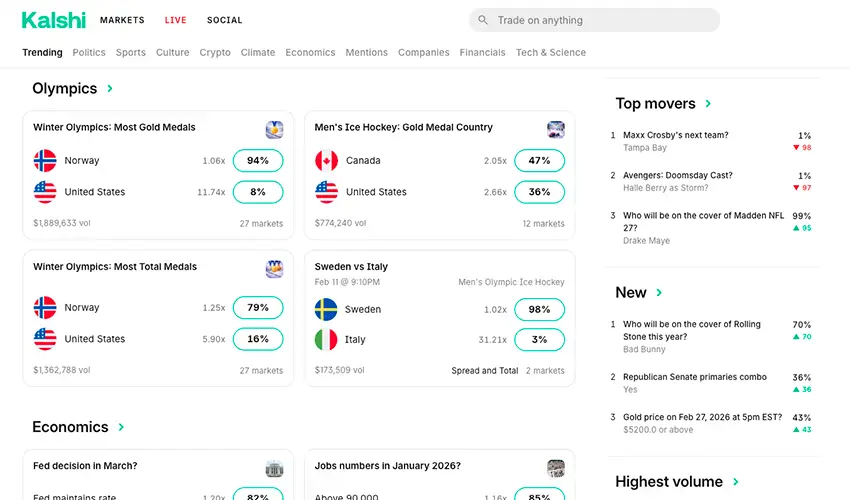
Kalshi focuses on measurable real-world events that can be objectively verified when markets settle.
- US politics and elections
- Economic indicators such as inflation or interest rates
- Weather events like temperature records or snowfall
- Sports milestones and major competitions
- Cultural or societal events
Key Characteristics of Kalshi
- CFTC-regulated prediction market exchange offering event contracts on real-world outcomes such as politics, economics, sports, weather, and culture.
- Contracts trade between $0 and $1 and settle based on clearly defined outcomes rather than traditional sportsbook odds.
- Supports multiple funding methods, including debit card, ACH bank transfer, PayPal, Venmo, Cash App, wire transfer, and crypto, although some options vary by region.
- Debit card deposits can carry up to a 2% processing fee, while ACH, wire, PayPal, and Venmo deposits do not have Kalshi processing fees.
- Available to US users within a regulated exchange framework, with some access differences by jurisdiction and separate payment limitations for international users.
What Is Polymarket?
Polymarket is a crypto-based prediction market where users trade on the probability of real-world events. Instead of traditional betting odds, markets are structured as yes-or-no questions, and each share represents the likelihood that an event will occur. Prices range between $0 and $1, reflecting the market’s estimated probability of the outcome.
The platform runs on blockchain infrastructure and uses USDC for trading. Because it is built for crypto users, funding and trading work differently from regulated exchanges such as Kalshi.
How Polymarket Works
- Markets are structured around clear yes-or-no questions.
- Each share trades between $0 and $1 depending on the market’s estimated probability.
- If the event happens, “Yes” shares settle at $1 while “No” shares settle at $0.
- Traders can buy or sell shares at any time before the market resolves.
Types of Markets on Polymarket
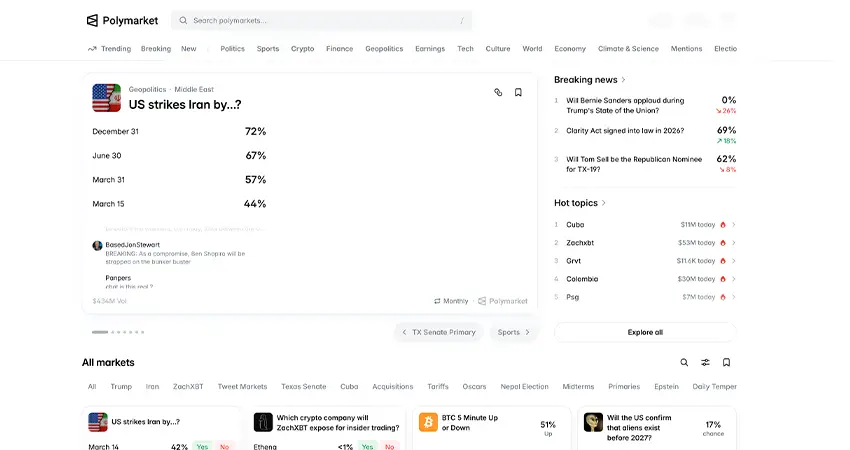
Polymarket lists a wide range of markets tied to current events and global news. These often change quickly as new information appears.
- Politics and elections
- Crypto developments and blockchain news
- Financial and economic indicators
- Sports milestones and championships
- Technology and cultural events
Key Characteristics of Polymarket
- Crypto-based platform using USDC for deposits and trading.
- Large number of fast-moving markets related to news and global events.
- Open participation for most international users.
- Limited direct access for US users because of regulatory restrictions.
Because of this structure, Polymarket tends to attract crypto traders and users who want a large variety of markets. When people compare Kalshi vs Polymarket, the discussion often focuses on regulation, market variety, and whether a user prefers a regulated US exchange or a crypto-native prediction market platform.
Kalshi vs Polymarket: Head-to-Head Comparison
Kalshi and Polymarket both allow users to trade on future events, but the way they operate is very different. The biggest differences appear in regulation, available markets, fees, and accessibility for US users. Looking at these factors side by side makes it easier to understand which platform fits your trading style.
Markets and Event Coverage
Both platforms offer markets based on real-world events, but the range and style of markets differ.
- Kalshi: Focuses on structured, measurable events such as inflation rates, election results, weather data, and sports milestones.
- Polymarket: Covers a wider range of topics including politics, crypto, global news, sports, and pop culture events.
- Market speed: Polymarket often lists new markets quickly after news breaks, while Kalshi markets tend to be more curated.
If you want structured contracts tied to official data releases, Kalshi may feel more familiar. If you prefer a wider variety of fast-moving markets tied to global news, Polymarket usually offers more options.
Fees and Trading Costs
Trading costs are one of the key differences between Kalshi and Polymarket, and this area has changed recently.
- Kalshi: Charges trading fees based on contract price and position size, following a structure similar to traditional exchanges.
- Polymarket: Updated its fee model on March 30, 2026. Most markets now include trading fees, typically applied at execution (similar to maker/taker structures), replacing the earlier model where many markets were fee-free with limited taker fees.
- Deposits: Kalshi may charge fees for certain payment methods, while Polymarket users typically fund accounts with USDC or supported onramps.
In practice, Polymarket’s pricing is now closer to a conventional exchange model, which reduces the cost difference between the two platforms for frequent traders.
Accessibility and Regulation
Regulation remains one of the biggest differences between the two platforms, but this area is evolving quickly.
- Kalshi: Operates as a CFTC-regulated exchange in the United States. However, access is currently inconsistent due to state-level litigation. An active injunction in Nevada restricts operations there, while similar action in New Jersey did not result in the same restriction. This means availability can differ depending on the user’s state.
- Polymarket: Runs two distinct platforms. The main platform is a crypto-based prediction market available internationally but not to US users. Separately, Polymarket US is operated by QCX LLC as a CFTC-regulated designated contract market (DCM), with its own legal framework, onboarding process, and app-based access.
- User base: Kalshi primarily targets US traders within a regulated framework, while Polymarket splits its audience between international crypto users and a separate US-regulated user segment.
Because of these developments, access conditions and platform structure can vary depending on jurisdiction, so users comparing Kalshi vs Polymarket should check the latest availability before signing up.
User Experience and Platform Design
The two platforms also feel different in terms of design and trading interface.
- Kalshi: Looks similar to a financial trading platform with an order book and structured contracts.
- Polymarket: Has a crypto trading interface designed for quick speculation on current events.
- Funding: Kalshi supports traditional funding methods, while Polymarket relies on crypto wallets and USDC.
For new users, Kalshi may feel more familiar because it resembles other regulated trading platforms. Polymarket, on the other hand, is often preferred by crypto users who already trade through wallets and decentralized tools.
Kalshi vs Polymarket: Which Is Better for You?
Choosing between Kalshi and Polymarket mostly comes down to regulation, market variety, and how you prefer to fund your account. Both platforms allow users to trade on the probability of real-world events, but they attract different types of traders.
Kalshi May Be Better If You:
- Want to use a prediction market that is legally accessible in the United States.
- Prefer a regulated exchange overseen by the Commodity Futures Trading Commission.
- Are more comfortable funding accounts with traditional payment methods instead of crypto.
- Prefer markets tied to measurable economic, political, or weather events.
Polymarket May Be Better If You:
- Already use crypto wallets and prefer trading with USDC.
- Want a wider range of markets tied to breaking news and global events.
- Prefer fast-moving markets with high trading activity.
- Are located outside the United States and can access the platform directly.
We find that traders looking for a regulated environment often lean toward Kalshi, while crypto-native traders tend to prefer Polymarket. The platforms serve different audiences, so the better choice depends on whether you prioritize regulation and US access or market variety and crypto trading.
If you want a regulated prediction market available in the US, Kalshi is usually the safer choice. If you want a broader range of markets and already trade with crypto, Polymarket may feel more flexible.
Explore More Prediction Market Platforms
If you want to explore more platforms beyond Kalshi and Polymarket, you can read our full comparison guide covering the top prediction market sites available today.
Kalshi vs Polymarket FAQ
Find answers to common questions bettors like you have when choosing a prediction market site.
Kalshi operates as a CFTC-regulated exchange in the United States, but availability can still vary by state while litigation continues. For example, courts recently allowed Kalshi to keep operating in New Jersey, while Nevada has had an active injunction affecting access there. Polymarket works differently: its main international crypto platform is not available to U.S. users, but Polymarket US, operated by QCX LLC, is a separate CFTC-regulated designated contract market with its own onboarding and product structure.
The biggest difference is regulation and platform structure. Kalshi is a CFTC-regulated exchange offering event contracts within the United States, although access may vary by state. Polymarket operates a global crypto-based platform for international users, alongside a separate US-regulated exchange (QCX LLC) with different access rules, onboarding, and product structure.
Polymarket generally lists more markets, especially around breaking news, politics, and crypto developments, with new markets often appearing quickly as events unfold. Kalshi focuses on structured markets tied to measurable outcomes such as economic data releases, elections, or weather events, which results in a more curated selection.
Yes. Kalshi charges trading fees based on contract price and position size, and it can charge up to 2% on card deposits, while ACH deposits and withdrawals do not carry Kalshi fees. Polymarket updated its fee model on March 30, 2026: most fee-enabled categories now charge taker fees, while makers are not charged fees. Some categories, including geopolitical/world events, remain fee-free.
Yes, beginners can use both platforms, but the experience differs. Kalshi may feel easier for new users because it supports traditional funding methods and follows a structure similar to regulated exchanges. Polymarket may suit users who are already familiar with crypto wallets and USDC-based trading, especially on its international platform, while its US version has a separate onboarding process.

Luke Chadwik is an experienced writer with a focus on European football, but has always had a keen passion for sport and follows all major leagues across the world. When Luke isn't writing about sports, he's focused on his passion for road biking or spending time with his twin daughters.