Crypto Prediction Markets: Bitcoin and DeFi Event Trading
 by
Chris Wassel
by
Chris Wassel
SUMMARY
- What Are Crypto Prediction Markets?
- How DeFi Prediction Markets Work
- Examples of Crypto Prediction Markets
- Crypto Prediction Markets vs Traditional Betting
- Risks and Limitations of Crypto Prediction Markets
- Are Crypto Prediction Markets Legal?
- Prediction Markets vs Crypto Trading vs Traditional Betting
- Best Crypto Prediction Market Sites
Crypto prediction markets combine event trading with the infrastructure of crypto markets, allowing users to speculate on outcomes using digital assets and blockchain-based platforms. Instead of relying on a bookmaker, these markets run on trading activity, where prices shift continuously as users react to new information and price movements.
Unlike traditional betting, many crypto platforms operate through wallets and smart contracts, giving users direct control over funds and positions. This creates a trading environment that feels closer to crypto exchanges than sportsbooks, with 24/7 markets and instant reaction to news.
In this guide, we break down how crypto prediction markets work, what makes them different from both sportsbooks and crypto trading, and how factors like liquidity, volatility, and market structure shape the way these platforms operate.
What Are Crypto Prediction Markets?
Crypto prediction markets are platforms where users trade contracts based on the outcome of events using cryptocurrencies. Instead of relying on a bookmaker, these markets use blockchain-based systems where prices move based on supply and demand.
Many of these platforms operate through wallets and smart contracts. In a bitcoin prediction market, users connect a crypto wallet, fund it with digital assets, and trade directly against other participants without a centralized operator.
Markets are typically built around clear outcome-based questions. Traders take positions depending on whether they believe the event will happen.
- “Will Bitcoin reach $100,000 by the end of the year?”
- “Will a spot Bitcoin ETF be approved?”
- “Will a major blockchain upgrade launch on schedule?”
Prices usually range between 0 and 1. A contract trading at 0.60 implies a 60 percent probability of that outcome. As traders react to price movements, regulation updates, and crypto market news, those prices adjust in real time.
This structure makes crypto prediction markets more flexible than traditional betting, as users can enter and exit positions at any time instead of waiting for a fixed result.
How DeFi Prediction Markets Work
DeFi prediction markets rely on blockchain infrastructure rather than centralized operators. Instead of accounts held by a platform, users interact directly with smart contracts using wallets, tokens, and on-chain settlement systems.
Wallets and access
Users connect a crypto wallet such as MetaMask to access the platform. The wallet acts as both the account and custody layer, meaning users keep control of their funds instead of depositing into a centralized system.
Tokens and collateral
Most platforms use stablecoins such as USDC as the base currency. When a user takes a position, they lock tokens as collateral into a smart contract.
In many DeFi prediction markets, positions are represented by tokenized outcomes. For example, systems based on conditional tokens (such as those used in Gnosis-based markets and Polymarket’s design) create separate “Yes” and “No” tokens as ERC-20 assets. These tokens can be traded, held, or sold before the event resolves.
On-chain pricing and liquidity
Prices are usually managed through automated market makers rather than traditional order books. Many platforms use constant product market maker (CPMM) or similar models, where liquidity pools hold collateral and adjust prices based on trading activity.
This means:
- Buying increases the implied probability of an outcome
- Selling decreases the implied probability
- Larger trades move prices more due to the liquidity curve
Oracle-based resolution
When a market ends, the result is determined using an oracle. DeFi prediction markets commonly rely on oracle systems such as UMA, which use a dispute-based resolution process where outcomes can be challenged before final settlement.
Oracles provide verified real-world data, such as election results, price levels, or official announcements, which the smart contract uses to resolve the market.
Settlement and payouts
In DeFi-native platforms, settlement happens on-chain. Once the oracle confirms the outcome:
- Winning outcome tokens can be redeemed for collateral
- Smart contracts distribute funds automatically
- Losing tokens expire with no value
Payouts are sent directly to the user’s wallet, without manual withdrawal requests.
Because of this structure, DeFi prediction markets operate continuously, with transparent pricing, tokenized positions, and automated settlement driven by smart contracts and oracle systems.
Examples of Crypto Prediction Markets
Crypto prediction markets often focus on events related to digital assets, blockchain technology, and macro trends that affect the crypto space. These markets attract active trading because new information can quickly change expectations.
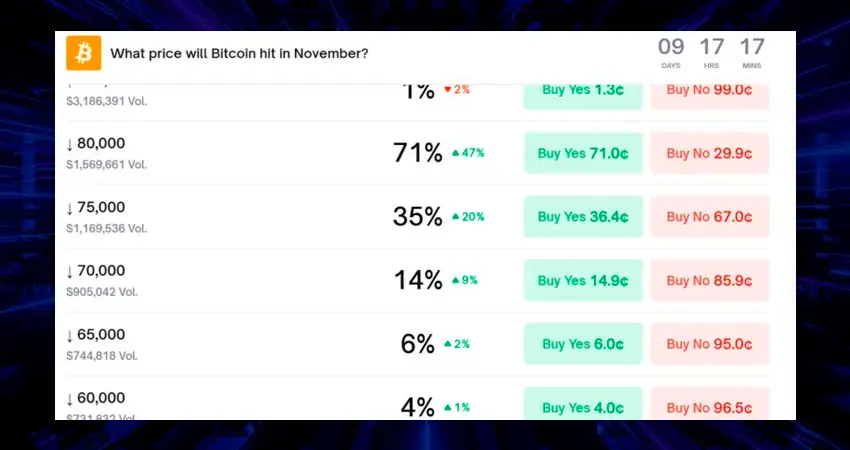
Examples of active markets include:
- Whether Bitcoin will reach a specific price level by a set date
- The future price range of Ethereum over a defined period
- Approval of crypto ETFs or regulatory decisions
- Outcomes of major blockchain upgrades or forks
- Adoption milestones for networks or protocols
Because crypto markets operate continuously, prices can react immediately to news. Announcements from regulators, exchange developments, or large price movements can quickly shift probabilities in a bitcoin prediction market.
These examples show how crypto prediction markets differ from traditional betting. Instead of placing a single wager, users can actively trade positions as market sentiment evolves.
Crypto Prediction Markets vs Traditional Betting
Crypto prediction markets and traditional betting platforms both let users take positions on future outcomes, but they work in very different ways. The main difference is that crypto prediction markets use user-driven prices, while sportsbooks and betting sites rely on bookmaker-set odds.
- Pricing: Crypto prediction markets use prices that reflect market sentiment, while betting odds are set and managed by the bookmaker
- Access: Many crypto platforms use wallets and digital assets instead of standard deposits and account balances
- Flexibility: Users can often buy and sell positions before the event resolves instead of holding a fixed bet
- Market structure: A bitcoin prediction market reflects probability through contract pricing rather than traditional odds formats
This structure makes crypto prediction markets more dynamic than regular betting. Users can react to price moves, breaking news, and volatility in real time instead of placing one wager and waiting for settlement.
Traditional betting is still simpler for most users. Sportsbooks offer familiar formats, straightforward bet slips, and easier onboarding, while crypto markets usually require more understanding of wallets, tokens, and trading mechanics.
Risks and Limitations of Crypto Prediction Markets
Crypto prediction markets offer flexibility and open access, but they also come with risks that users should understand before trading.
- Volatility: Crypto markets can move quickly, and prices in a bitcoin prediction market may shift sharply in response to sudden news or large trades
- Liquidity: Some markets may have limited trading volume, making it harder to enter or exit positions at stable prices
- Platform risk: Not all crypto prediction markets operate under clear regulatory frameworks, which can affect user protections
- Smart contract risk: Blockchain-based platforms rely on code, and errors or vulnerabilities can impact market outcomes
While crypto prediction markets create more opportunities for active trading, they require users to understand both market behavior and the technical side of using wallets and decentralized platforms.
Are Crypto Prediction Markets Legal?
The legality of crypto prediction markets depends on your location, how the platform is structured, and whether it operates under a regulated framework or through decentralized systems.
In the United States, prediction markets that offer event contracts must operate under oversight from the Commodity Futures Trading Commission. Platforms such as Kalshi are registered as designated contract markets, and QCX LLC, which operates Polymarket US, is also listed under the same regulatory structure. Even within this framework, access is not uniform. Ongoing enforcement and legal challenges mean availability can vary by state, with different outcomes in jurisdictions such as Nevada and New Jersey.
Alongside these regulated exchanges, there are crypto-based prediction markets that operate internationally using blockchain infrastructure. The main Polymarket platform is one example. It uses USDC, smart contracts, and oracle-based resolution through systems like UMA, but it is not available to US users and is not regulated by the CFTC. This creates a clear split between regulated US exchanges and offshore or international crypto platforms.
Decentralized prediction markets go a step further by removing the central operator entirely. These platforms use smart contracts, tokenized outcome positions, and on-chain settlement. While the infrastructure is open, access is still shaped by practical restrictions. Many front-end interfaces apply geo-blocking, and users may need to rely on specific wallets or tools to interact with the contracts.
For users, the key issue is access rather than a simple yes-or-no legality answer. A platform may be fully regulated and available in one region, restricted in another, and technically accessible but not approved under local law in a third. Before using any crypto prediction market, it is important to check whether the platform is available in your jurisdiction, how it is regulated, and what restrictions apply to funding, trading, and withdrawals.
Prediction Markets vs Crypto Trading vs Traditional Betting
Crypto prediction markets, crypto trading, and traditional betting all involve speculating on outcomes, but they differ in structure, pricing, and user interaction.
| Feature | Crypto Prediction Markets | Crypto Trading | Traditional Betting |
|---|---|---|---|
| How it works | Users trade contracts on event outcomes | Users buy and sell assets like Bitcoin or Ethereum | Users place fixed bets on outcomes |
| Pricing | User-driven probability pricing (0 to 1) | Market price based on supply and demand | Odds set by bookmaker |
| Flexibility | Positions can be entered and exited anytime | Assets can be traded anytime | Bets usually fixed after placement |
| Focus | Specific event outcomes | Asset price movements | Game or event results |
| Reaction to news | Immediate price changes | Immediate price changes | Odds adjusted periodically |
This comparison shows how crypto prediction markets sit between trading and betting. A bitcoin prediction market combines elements of both, allowing users to trade probabilities on events rather than directly trading asset prices or placing fixed wagers.
Best Crypto Prediction Market Sites
If you want to use crypto prediction markets, the platform you choose matters. Differences in liquidity, fees, supported assets, and market variety can have a direct impact on trading experience and outcomes.
You can explore our full guide to the best prediction market sites, where we compare platforms based on usability, pricing, and market depth.
For more detailed breakdowns of specific platforms, see our reviews:
Crypto Prediction Markets FAQ
Find answers to common questions bettors like you have when choosing a prediction market site.
Crypto prediction markets are platforms where users trade contracts on the outcome of events using cryptocurrencies. Prices reflect probability and move based on user activity rather than bookmaker odds.
A bitcoin prediction market allows users to trade event-based contracts using Bitcoin or other crypto assets. Users buy and sell positions, and prices adjust in real time based on supply and demand.
No, crypto prediction markets focus on event outcomes, while crypto trading involves buying and selling assets like Bitcoin or Ethereum based on price movements.
Some users make profits by identifying mispriced probabilities or reacting quickly to crypto market news. However, risks such as volatility and low liquidity can also lead to losses.
Crypto prediction markets are not legal everywhere. The rules depend on your location and on how the platform is set up. In the U.S., event contracts generally need to be offered through a CFTC-regulated exchange, such as Kalshi or Polymarket US. By contrast, Polymarket’s international platform blocks U.S. users and other restricted regions. Before trading, users should check whether the platform is available where they live and what local rules apply.

Chris Wassel is a veteran sports writer, editor, and betting analyst with nearly three decades of experience covering sports, fantasy sports, and wagering. A longtime member of the Fantasy Sports Writers Association (FSWA), the Fantasy Sports & Gaming Association (FSGA), and several sports betting communities, Chris has built a reputation for combining d...
Read More About the Author