Prediction Markets in California
 by
Dan Favale
by
Dan Favale
SUMMARY
- What prediction markets are
- The current California and federal picture
- Is Kalshi legal in California? What about Polymarket, PredictIt and Novig?
- Prediction markets vs sportsbooks vs DFS
- Why California tribes and regulators care about prediction markets?
- What California users should check before using a prediction platform
The question of are prediction markets legal in California has a complicated answer. Technically speaking, they are not illegal. But their operations are being heavily contested by a number of state officials.
Prediction markets are available in California under a federal event-contract model, but they are not California-licensed sportsbooks and remain subject to ongoing legal and political challenges. The federal government differentiates the services they provide from the status of California sports betting, which remains illegal. And because of that view, various companies have launched prediction markets in the Golden State, including those who also run sportsbooks and have been waiting for California to amend its constitution to legalize them.
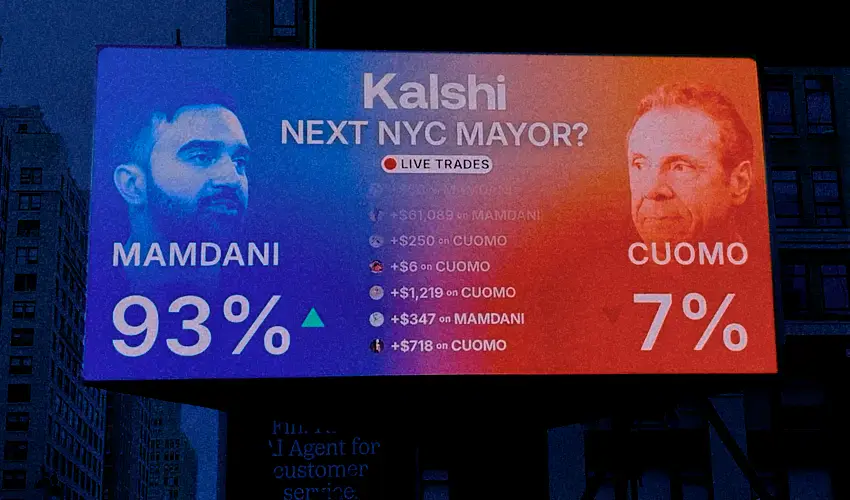
Sites like Kalshi and Polymarket can be accessed by residents of the state without any muss or fuss. More recently, DraftKings and FanDuel have moved into prediction markets, but these products are still distinct from California-licensed sportsbooks and remain controversial in the state. Granted, their rollouts are not without push-back. In March 2026, Governor Gavin Newsom barred gubernatorial appointees from using non-public information for profit in prediction markets. But there’s nothing currently stopping regular ol’ citizens from accessing one of the handful of California prediction market sites, so long as they are at least 18 years of age.
If this remains the case as other states (plural) take action against prediction markets or when the current presidential administration vacates office remains to be seen.
Legal status snapshot (California):
- Prediction markets are not classified as traditional sports betting
- They fall under federal regulation via the CFTC
- California does not directly regulate these platforms
- State officials and tribal groups are actively challenging their presence
- Availability remains subject to ongoing legal and political developments
What prediction markets are
Since prediction markets in California are relatively new to the mainstream, many still don’t understand what separates them from sports betting. To call this understandable would be understatement. Sports betting and prediction markets share a lot of the same DNA.
The primary difference between the two is prediction markets use what they call “event contracts” for transactions rather than bet slips. These event contracts are tantamount to yes-or-no investments in potential outcomes, and they are not just limited to sports, either. You can “invest” in pretty much everything, political elections, awards shows, movie release dates, the weather and basically anything else you can imagine.
For instance, let’s say you’re visiting Kalshi California and want to purchase an event contract that stipulates “yes, it will rain tomorrow.” You can buy as many “shares” in this event occurring as you please. Each share will be priced at less than $1 and reflect the perceived likelihood of it raining tomorrow. If a “Yes” contract trades at $0.65, the market price implies roughly a 65% probability before fees and market movement, although prices can change as users buy and sell.

How prediction markets work
By setting transactions up in this manner, prediction markets are federally regulated by the Commodity Futures Trading Commission (CFTC). This is the same commission that oversees stock options: swaps, futures, and certain kinds of options. Falling under this umbrella means states do not have the power to shut down prediction markets. When the Supreme Court of the United States overturned the Professional and Amateur Sports Protection Act in 2018, it gave local governments the license to legalize and regulate sports betting. It did not address markets that fall under derivatives.
On top of all that, California prediction markets have further inoculated themselves against crossing into sports betting territory by how companies make money.
When you bet on sports in the United States, you are wagering against “The House,” which is to say, a sportsbook. If your bet doesn’t pan out, The House collects all the money you wagered. Prediction markets, however, operate more like exchange-style products where users buy and sell contracts with other market participants.
To stick with our “Will it rain tomorrow” example, all the money invested in that event gets pooled together. Once the transaction is settled, Kalshi, Polymarket, DraftKings, FanDuel, etc. will take a percentage of the pool to cover taxes and service fees. The remaining money will be distributed to the winners depending on how many “shares” they purchased, and the price they paid at the time of their transaction.
The current California and federal picture
Just because prediction markets are permitted under federal law doesn’t mean they are accepted by the state’s governing body. In California’s case, it most certainly is not.
Tensions are unavoidable given that the state has yet to legalize sports betting. Tribal nations are supposed to have gambling exclusivity in the state, and while prediction markets aren’t classified as sports betting, they allow companies to make money off the same sporting events that would be hot commodities if sports betting in California was legal. Tribal nations see prediction markets as infringing upon their territory. They don’t want the state answering the question of “Is Kalshi legal in California?” with a resounding yes.
Beyond that, state officials, such as Governor Gavin Newsom, see prediction markets as sidestepping their power. California generally regulates its own gambling laws, from sports betting to horse racing to casino gaming. They do not have regulatory oversight of prediction markets, because they are considered commodities or derivatives rather than forms of gambling. These markets are instead subject to the purview of the CFTC.
The CFTC’s Feb. 4, 2026 event-contracts release is an important federal reference point because it withdrew an event-contracts rule proposal and a staff sports-event-contracts advisory, reinforcing why the federal picture remains active and unsettled.
The future of prediction markets
What’s more, tensions only figure to increase. While prediction markets are most linked to sporting events and thus tied to sports betting, they have grown in popularity within the political sector. We are not just talking about event contracts on elections. Prediction markets allow you to invest in things like the price of oil going up, if the United States will attack Iran, how much funding the Department of Homeland Security receives and so much more.
Increased ties to political events have led to claims of insider trading-esque activity on prediction markets. Vast amounts of money have been “invested’ in certain decisions made by President Donald Trump just hours or even minutes before he makes them. Many of these event contracts are bankrolled by anonymous accounts, leading to the belief that purchases were made by people with direct knowledge behind the scenes.
State officials tend to argue this is illegal. Yet, prediction market operators actually encourage those with intimate knowledge of certain events to make purchases in an attempt to move the market in the right direction. This moralistic tug-of-war has led to the Senate passing legislation that bans government employees from using prediction markets to make money off real-world outcomes of which they have insider knowledge.
Is Kalshi legal in California? What about Polymarket, PredictIt and Novig?
Which prediction markets can be accessed by people. Let’s run through the biggest names in the industry and find out.
| Platform | Status in California | Type | Notes |
|---|---|---|---|
| Kalshi | Accessible | CFTC-regulated prediction market | Operates under federal event-contract framework |
| Polymarket US | Rolling out / availability may vary | CFTC-regulated prediction market | Access may depend on rollout and eligibility |
| PredictIt | Accessible | Prediction market | Operates under a separate regulatory structure |
| Novig | Unclear / do not present as currently accessible | Prediction-market applicant | Status should be treated cautiously |
| ProphetX | Not available | Peer-to-peer betting exchange | Not presented as a live California option |
Kalshi
Is Kalshi legal in California? Kalshi is accessible in California through its CFTC-regulated event-contract model, but it is not a California-licensed sportsbook and its status remains part of the wider state-versus-federal prediction-market debate.
Despite push-back from state officials, Kalshi launched its California prediction market back in 2021. Services have run without interruption ever since. In fact, California is Kalshi’s bread and butter. According to Eilers & Krejcik Gaming, around 43 percent of all Kalshi’s trading volume comes from the Golden State.
Polymarket
Is Polymarket legal in California? Polymarket US is returning under a CFTC-regulated structure, but availability in California may depend on rollout and eligibility.
Unlike Kalshi, Polymarket was forced to leave the United States when it was determined their services too closely mirrored gambling. However, they began returning to the U.S. after President Donald Trump won the 2024 election. Though Polymarket US is returning under a CFTC-regulated structure, access in California may depend on rollout status and account eligibility.
Novig
Is Novig legal in California? Novig’s status in California is unclear, and it is safer not to describe it as currently legal and accessible in the state.
Novig has pursued prediction-market approval at the federal level, but reporting in 2026 said that process was still pending, so the page should not state that Novig is currently accessible in California as a settled fact.
PredictIt
Is PredictIt legal in California? Yes, PredictIt is considered legal in California.
Back in 2025, PredictIt won the right to expand its prediction-market offerings across the U.S. and California. They never released the details of their agreement with the CFTC, but there is speculation that the terms have impacted the lower maximum limits they set on event contracts.
ProphetX
Is ProphetX legal in California? No, ProphetX is not considered legal in California.
Unlike the prediction market operators listed above, ProphetX’s model has been identified as peer-to-peer gambling. As such, California’s crackdown on sweepstakes-style transactions have nudged it out of the market. However, the company has applied for prediction-market approval with the CFTC.
DraftKings Prediction
Is DraftKings Prediction legal in California? DraftKings Predictions should be described as a prediction-market product, not as DraftKings Sportsbook or a California-licensed sportsbook.
After initially opting against launching in California, DraftKings Prediction rolled out services in the Golden State before the end of 2025. They were initially worried their prediction markets would damage relationships with tribal nations, whose collaboration will be required to legalize sports betting. In the end, though, it seems California sports betting legalization wasn’t imminent enough for DraftKings to remain on the sidelines.
FanDuel Predicts
Is FanDuel Predicts legal in California? FanDuel Predicts should be described as a prediction-market product, not as FanDuel Sportsbook or a California-licensed sportsbook.
Like DraftKings Prediction, FanDuel Predictions originally restricted its markets to states other than California. As of January 2026, though, they elected to launch their prediction-market services in the Golden State.
Prediction markets vs sportsbooks vs DFS
What separates prediction markets from sportsbooks and daily fantasy sites (DFS)? Let’s break it all down.
| Feature | Prediction Markets | Sportsbooks | DFS (Daily Fantasy Sports) |
|---|---|---|---|
| Regulation | Federal (CFTC) | State-level | State-level |
| How You Participate | Buy/sell event contracts | Bet against the house | Enter contests with lineups |
| Opponent | Other users | The sportsbook | Other users |
| Markets Available | Sports, politics, economics, events | Primarily sports | Sports only |
| Legal Status in CA | Contested but accessible | Illegal | Restricted / contested |
Prediction markets vs sportsbooks
The sportsbook vs prediction markets topic is among the most hotly contested in the industry. That’s largely because it can be difficult to spot the differences. Both operations provide you with the ability to win money on sporting events, political topics and so much more.
All of the most noticeable differences come down to how transactions are presented. At sportsbooks, you wager money against “The House” (i.e. the sportsbook itself). If you win, the sportsbook pays you out of their pocket. If you lose, the sportsbook pockets all of your money.
Prediction markets, on the other hand, pit you against other people wagering on the same event. For example, if you purchase an event contract that answers “yes” to the question of “Will the Los Angeles Rams win the NFL Super Bowl,” you are betting against anyone who invested in the answer being “no.” As a result, all of the money from both sides of the question gets put into a pool. Once the event is resolved, a prediction market like Kalshi California removes a percentage of the total money to cover taxes and an operator’s fee. Then, the pool of money remaining gets distributed to the winners, with each person’s payout contingent upon how much they put in, and the price per share (i.e. the odds) under which they made their wager.
This distinction allows prediction markets to fall under federal regulation, via the CFTC, despite California sports betting remaining illegal.
Prediction markets vs daily fantasy sites
For the most part, DFS vs prediction markets isn’t considered a primary debate. Still, like prediction markets, daily fantasy sites in California bill themselves as transactions that don’t qualify as sports betting. And yet, they have faced more successful resistance from lawmakers than prediction markets.
What gives, exactly? Federal vs. state regulation.
In California, paid DFS remains contested, and the state Attorney General concluded in 2025 that paid DFS games involving players physically located in California are prohibited under existing law. Prediction markets, on the other hand, are overseen by the federal government. So where the CFTC can hand out operational licenses to prediction markets, daily fantasy sites must receive approval from state governments. The latter, of course, is harder to come by. Many states must collaborate on DFS with tribal nations, because tribal nations tend to have gaming exclusivity. Beyond that, state taxes tend to be higher than federal ones, which complicates the negotiating process between both members of congress and daily fantasy sites themselves.
There is also a distinct difference in subject matter. Daily fantasy sites traffic in transactions specifically tied to individual athlete stat lines in a given event. Prediction markets cover, well, basically everything, including events and outcomes that have nothing to do with sports.
Why California tribes and regulators care about prediction markets?
If you find yourself wondering why the answer to “Are prediction markets legal in California?” is such a critical inflection point, look no further than the constitution.
The Golden State’s constitution grants gaming exclusivity to tribal nations. This is why they are allowed to operate game rooms despite gambling in California not being legalized.
Tribal collaboration is therefore paramount when attempting to rewrite the state’s gaming laws. The reason attempts to legalize sports betting in California have failed so far is that tribal nations are fiercely protective of their exclusivity. They do not want corporations, like those behind prediction markets, coming in and cannibalizing their market share. As entrenched as tribal operators might be in the state, they do not have the same reach or resources as these larger companies.
Similar to daily fantasy sites, prediction markets in California pose an existential threat to tribal business models. While these operators are technically making money off services tribes cannot offer, they create competition merely as an alternate form of gaming. Which, again, is supposed to be exclusive to tribes.
Bake in the millions, if not billions, of dollars at stake, and it’s not hard to see why tribal nations are almost universally opposed to California prediction markets.
What California users should check before using a prediction platform
Participating in prediction markets in California isn’t as simple as just signing up and getting started. This is to say, it goes well beyond simply searching “Kalshi availability in California.” You need to make sure you understand the nuts and bolts of how everything works, just like you need to when figuring out how to bet on sports in California.
Here are a few things you need to research and keep in mind when choosing a prediction market.
- Verify age requirements: Most platforms require users to be at least 18 years old.
- Complete KYC checks: Be prepared to submit identification documents to verify your identity.
- Understand fees: Platforms may charge 1%–3% per trade or transaction.
- Review contract settlement rules: Know when and how contracts resolve and if early exits are allowed.
- Check platform availability: Access and features can change depending on regulatory developments.
- Compare market types: Some platforms focus on sports, while others include politics and economic events.
KYC and age regulations
Even though California prediction markets can operate in a gray area, they are still keyed in on know-your-customer tactics (KYC) and age limits. Not only must you be a minimum of 18 years old to invest in prediction markets, but sites will ask for various forms of identification to confirm that you are who you say you are and how old you are.
Circumventing this process comes with all sorts of warnings. Kalshi and Polymarket, in particular, have gone to great lengths to weed out underage sign-ups.
Cover fees
Just as sportsbooks may charge a fee for processing withdrawals or deposits, prediction markets have what they call a cover fee. These are usually a flat rate ranging from one to three per cent of your entire “trade.” Make sure you are accounting for that when choosing a platform and cobbling together your tickets.
Contract settlement
Contract settlements in prediction markets refer to the conclusion of your transaction. This can happen in one of two ways.
Let’s say you are buying “yes” shares to answer the question “Will the Los Angeles Lakers win the NBA championship?” Your contract will be settled once they win the title, or when they are eliminated. Beyond that, though, you can sometimes sell off your contract before the outcome is settled. This is typically done when the purchase price has increased since you bought an event contract. Let’s say the Lakers winning the title cost $0.37 per share when you purchased it during the regular season. When the start of the playoffs rolls around, however, you see that it’s trading at $0.53 per share. At that point, you have the ability to sit tight, or cash out by selling off your contract and pocketing the difference of $0.16 per share (minus fees).
Prediction Markets in California FAQ
Find answers to all the most pressing questions you have about California prediction markets.
Yes, but it’s complicated. Prediction markets are still operating in California, but they face strong opposition from state officials and tribal nations, who argue they amount to gambling and may violate tribal gaming exclusivity.
For now, these platforms remain available because they are structured as event contracts and fall under federal oversight from the CFTC, not California regulators. Recent federal policy has also been more permissive, helping more prediction markets stay active in California.
Access in California may depend on Polymarket US rollout status, account eligibility, and available product access.
Yes, Kalshi is considered legal in California. Despite push-back from state officials, Kalshi launched its California prediction market back in 2021. Services have run without interruption ever since. In fact, according to Eilers & Krejcik Gaming, around 43 percent of all Kalshi’s trading volume comes from the Golden State.
No, ProphetX is not considered legal in California. Contrary to prediction market operators like Kalshi, FanDuel Predicts and Polymarket, ProphetX’s model has been identified as peer-to-peer gambling. As such, California’s crackdown on sweepstakes-style transactions have nudged it out of the market. However, the company has applied for prediction-market approval with the CFTC.
Novig’s California status should be treated as unclear. Do not describe Novig as clearly legal or currently accessible in California unless its current licensing, rollout, and California access are verified at publication time.

Basketball was Dan’s first love. Growing up, he would stay up late watching the end of New York Knicks games, living and dying with every shot and whistle. While basketball was also his favorite sport to play, he quickly came to realize a professional career was of the question. Soon after that revelation, he decided to channel his inner creativity and pu...
Read More About the Author Online betting sites