 by
by
Kalshi has been in a war for a good year now. And the war is not necessarily with its rivals in the prediction market space like Polymarket or the ones spun up by top sports betting apps (e.g. DraftKings Predictions).
Now the real war has been in courtrooms with regulators, state attorneys, and so on. This is likely to continue for years, but it definitely feels like things have escalated as of late.
That’s because Kalshi is now fighting a two-front war against arguably the two most important gambling states in America: California and Nevada. One is the country’s biggest state by population, and believed to have heavy Kalshi users since California sports betting doesn’t exist. The other is the undisputed capital of American gaming, Nevada.
Neither of the two giants appears to be backing down to Kalshi either. Keep on reading, and we’ll tell you what’s happening in both states (spoiler alert: more lawsuits!).
California Gets Aggressive Against Kalshi
For the longest of times, the state of California has dragged its feet with the growing giant that is prediction markets. A multitude of other states beat them to the punch on launching lawsuits despite California having way more to gain by keep prediction markets out of its restricted state.
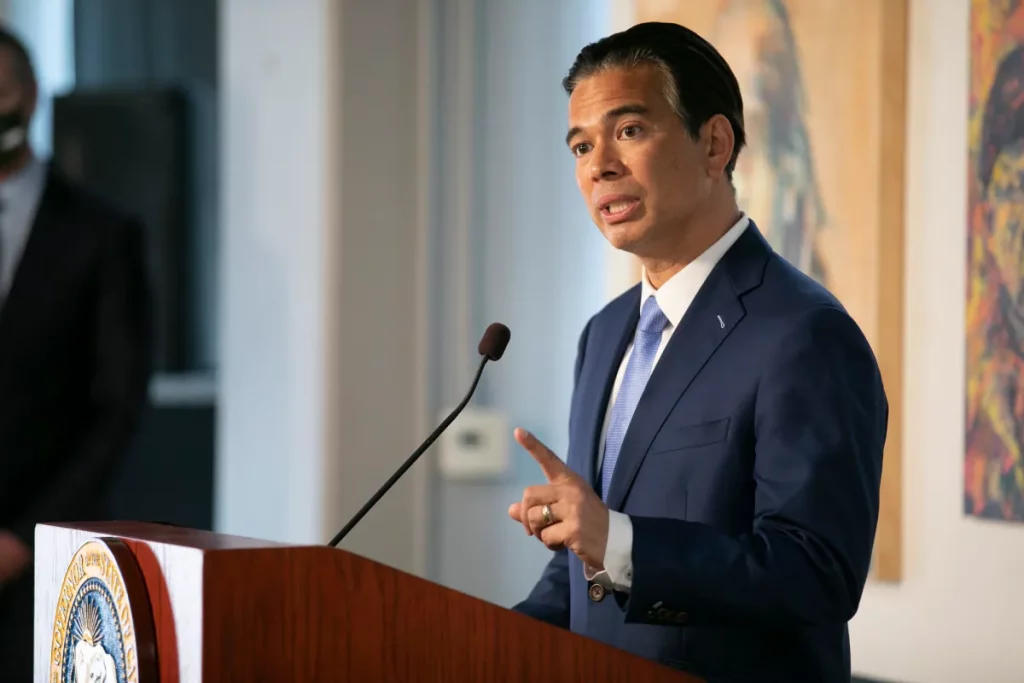
That was then though and this is now. Earlier this June, California Attorney General Rob Bonta announced the state joined a coalition of 37 other attorneys general backing Ohio in its legal fight against Kalshi.
Yes, there’s 36 other states involved, but the Golden State carries a little extra weight due to its size and richness. We mean, if California was a country, it would have the fourth-highest GDP (only China and Germany would be higher). In simple terms, California carries a big, big stick.
And so far, California has been staunchly opposed to any form of legal sports betting. In 2022, not one, but two different ballots that would’ve legalized the industry failed with disastrous results. Casino betting is allowed — though local Native American tribes — but there’s been little appetite to expand onto the sports world.
So you can see why the state would take offense when Kalshi openly allows sports “event contracts” where users can “predict” who’ll win what game or how a player will perform. Kalshi is fully accessible in California because it’s federally-allowed, but of course, California thinks it should have the right to allow it or not.
California AG Bonta has plenty of political incentive to keep pushing. He’s already inserted himself into fights involving daily fantasy sports, card rooms, betting terminals, and other gaming disputes. He’s firmly positioned himself as pro-tribal gaming rights and anti-everything that challenges it. Kalshi falls into the latter category.
For now, California remains a supporting character in the broader Kalshi fight, but it is becoming a much louder one.
Nevada Wants To Make An Example Out Of Kalshi
If California sees Kalshi as pain on their side, then Nevada sees it as an existential threat to its biggest industry. The state has already been squeezed out by the expansion of legal sports betting nationally (Nevada once had a monopoly on this) and the rise of tribal casinos. Kalshi is another threat along those same lines.
As a result, the Nevada Gaming Control Board recently asked a state court to hold Kalshi in contempt, arguing the company violated a court order requiring it to stop offering sports, election, and entertainment contracts within state lines. According to court filings, regulators want penalties of at least $120,000 per day for continued noncompliance. Kalshi has deep pockets, but even that’s a number they want to avoid.
The dispute centers around Kalshi’s attempt to block Nevada users after losing a preliminary injunction earlier this year. Kalshi says it complied by preventing users with Nevada IP addresses from accessing prohibited markets. However, Nevada regulators claim investigators were still able to purchase sports contracts while physically located inside Nevada multiple times after the court order took effect.
Even more interesting is Nevada’s argument about how Kalshi chose to solve the problem. The state says Kalshi relied on a cheap, in-house geolocation system that cost roughly $190,000 rather than using the more robust geofencing technology commonly used by the big-name sportsbooks. Nevada argues the company’s approach was insufficient from the start and that IP addresses alone are notoriously unreliable when determining a user’s location.
Here again, Kalshi is denying and denying some more. They said Nevada has refused to provide enough information about the alleged violations for it to investigate what actually happened. Kalshi’s position is essentially that the court ordered compliance, not a specific technological solution.
Contempt findings generally require someone to violate a clear and specific court order. Nevada believes Kalshi has done exactly that. Kalshi believes the state is “moving the goalposts” after the fact. A lot of bickering, ain’t it? Either way, a judge will eventually decide who’s in the wrong here.
But the larger takeaway is impossible to ignore. California is increasing its political and legal pressure. Nevada is escalating its enforcement efforts. And neither state appears interested in “meeting in the middle” with Kalshi. For a company like Kalshi that has built its entire future around challenging traditional gambling regulations, the fight is getting bigger, more expensive, and much harder to ignore.
 Online betting sites