World Cup 2026 Prediction Markets
 by
Tony Reyes
by
Tony Reyes
SUMMARY
- What are World Cup prediction markets?
- How World Cup prediction markets work
- Top World Cup prediction market platforms
- Prediction markets vs offshore sportsbooks for World Cup betting
- Best offshore sportsbooks for World Cup betting markets
- Where offshore sportsbooks usually beat prediction markets
- Where prediction markets can be useful
- How to compare prediction market prices with sportsbook odds
- How World Cup news moves prediction markets and sportsbook odds
- Legality of prediction markets vs sportsbooks
- Best World Cup betting promotions
- Common mistakes to avoid with prediction markets
- Final word on World Cup prediction markets
- Bet responsibly

Prediction markets are everywhere in 2026. Platforms like Kalshi and Polymarket let people trade on real-world outcomes as if they were stocks. The World Cup is one of the biggest events they cover.
But how do they actually work? And how do they stack up against a traditional sportsbook for World Cup betting? This page breaks down prediction markets in plain English. We compare them to offshore sportsbooks, explain how to read the prices and show you where each option makes sense.
What are World Cup prediction markets?
A prediction market is a platform where people trade contracts tied to an event’s outcome. Instead of betting against a sportsbook, you’re trading against other users. The price of a contract reflects the crowd’s view of how likely something is.
Think of it like a stock market for events. “Will Brazil win the World Cup?” becomes a tradable contract. If the price is 25 cents, the market thinks they’re roughly a 25% chance. You buy and sell those contracts as the odds shift.
That’s the core difference from a sportsbook. A sportsbook sets the odds and takes the other side of your bet. A prediction market just matches buyers and sellers and takes a small fee. Here’s how the key features translate.
| Prediction Market Feature | Sportsbook Equivalent | What It Means For You |
| Contract price (cents) | Odds/implied probability | Price equals the crowd’s
probability estimate |
| Buy a Yes contract | Back a selection | You profit if the outcome
happens |
| Buy a No contract | Bet against/lay | You profit if the outcome doesn’t
happen |
| Sell before settlement | Cash out | Lock in profit or cut losses early |
| Trading volume | Betting handle | More volume means tighter,
fairer prices |
| Other traders | The house | You’re trading peers, not the
book |
How World Cup prediction markets work
Every prediction market contract is a yes-or-no question. “Will Argentina reach the final?” You buy Yes if you think it happens. You buy NO if you don’t. Each contract settles at either 100 cents or zero.
The price sits somewhere between 1 and 99 cents. That price is the implied probability. A contract trading at 60 cents means the market sees a 60% chance. Buy it for 60 cents, and if it hits, you collect 100 cents. That’s a 40-cent profit per contract.
Prices move constantly as people trade. Good news for a team pushes its price up. A star injury pushes it down. The more money flowing through a market, the more liquid it is. High liquidity means you can buy and sell easily without moving the price much.
Settlement is the final step. When the event resolves, winning contracts pay out 100 cents each. Losing contracts go to zero. The platform takes a small fee on trades or winnings instead of building a margin into the odds like a sportsbook does.

Top World Cup prediction market platforms
Two names dominate the prediction markets space right now. Both will carry World Cup markets in 2026.
Kalshi. A US-based exchange regulated by the CFTC. It deals in event contracts across politics, economics, weather, and sports. Kalshi is known for operating within the US regulatory framework. Its sports event contracts have grown fast.
Polymarket. A crypto-based prediction platform that trades in stablecoins. It’s known for huge volume on major global events and a wide range of unusual markets. It runs on blockchain technology and settles in digital currency.
Both platforms price outcomes through trading rather than a bookmaker. They tend to shine on big, high-attention markets like the World Cup winner or whether a specific team advances. They are not traditional sportsbooks, and they don’t offer the full menu of soccer betting options that books do. Availability can vary by location, so always check each platform’s terms and your local rules before trading.
Favorites to reach the World Cup Final, via Kalshi:
29% — Spain
28% — France
25% — Portugal
21% — England
19% — Brazil
19% — Argentina
14% — Germany
13% — Netherlands pic.twitter.com/LGdHgHhHOX— Kalshi FC (@KalshiFC) June 1, 2026
Prediction markets vs offshore sportsbooks for World Cup betting
This is the comparison most bettors care about. Prediction markets and offshore sportsbooks both let you wager on the World Cup. They just do it very differently. Here’s how they stack up across the things that matter.
| Feature | Prediction Markets | Offshore Sportsbooks |
| Bet format | Yes/No contracts | Traditional odds and bet slips |
| Available markets | Mostly big-picture outcomes | Hundreds of markets per match |
| Player props | Limited | Extensive |
| Parlays | Not available | Yes, including same-game |
| Live betting | Some in-play trading | Full live betting menus |
| Bonuses | Rare | Welcome bonuses and free bets |
| Payments | Cash or crypto | Cards, crypto, wires, e-wallets |
For the full set of traditional betting markets, check out our World Cup betting hub.
Best offshore sportsbooks for World Cup betting markets
Prediction markets are interesting, but most bettors still prefer a full-service sportsbook. The depth of markets, bonuses, and bet types is hard to beat. Here are five offshore books worth a look for World Cup betting.
| Sportsbook | Why You Might Prefer It Over a Prediction Market |
| Bovada | Deep World Cup markets, strong props, easy mobile interface, crypto-friendly payments. |
| BetOnline | Wide range of soccer markets, live betting, parlays, and competitive futures odds. |
| Lucky Rebel | Generous bonuses, a modern interface, and a growing soccer betting menu. |
| BetUS | Long-running book with big welcome bonuses and full World Cup coverage. |
| Sportsbetting.ag | Strong prop and parlay options, live betting, and reliable payouts. |
Want to dig into specific markets? Our World Cup prop bets guide and Golden Boot odds page cover the markets that prediction platforms rarely offer.
Also check the reviews of the top offshore sportsbooks here and their short comparison here:


Where offshore sportsbooks usually beat prediction markets
For most World Cup bettors, a sportsbook simply offers more. Here’s where the books pull ahead.
Bonuses and free bets. Sportsbooks hand out welcome bonuses and reload offers. Prediction markets rarely do. That’s free value you won’t usually find when trading contracts.
Player props. Want Haaland to score or over 2.5 goals in a match? Sportsbooks have hundreds of these. Prediction markets stick to bigger outcomes.
Parlays. Combining multiple selections for a bigger payout is a sportsbook staple. Prediction markets don’t really do parlays.
Live betting and cash-out. Sportsbooks offer deep in-play markets and one-tap cash-out. Prediction markets have in-play trading but less polish for casual bettors.
Familiar bet slips. Most bettors already know how to read odds and build a bet slip. The contract-trading model takes some getting used to.
Where prediction markets can be useful
Prediction markets aren’t just an alternative to sportsbooks. They’re a useful tool even if you bet primarily at a book.
Reading public sentiment. The price tells you what the crowd thinks. If a team’s contract jumps, sentiment is shifting. That’s real-time market intelligence.
Implied probability check. A contract price is a clean probability. You can compare it against sportsbook odds to spot value on either side.
Liquidity-driven price movement. Big, liquid markets move fast on news. Watching them can tip you off before sportsbook lines adjust.
Unusual event markets. Prediction platforms sometimes list quirky markets that sportsbooks skip. Things like which player gets the most red cards or off-field storylines.
How to compare prediction market prices with sportsbook odds
This is where prediction markets get genuinely useful for bettors. The trick is converting everything to implied probability. Once both are in the same format, you can compare them directly.
A prediction market makes it easy. A contract at 40 cents equals a 40% implied probability. No math needed. The price is the probability.
Sportsbooks’ odds take one step. For positive American odds like +150, divide 100 by the odds plus 100. So 100 divided by 250 equals 40%. For negative odds like -150, divide the odds by the odds plus 100. So 150 divided by 250 equals 60%.
If the math isn’t your thing, our odds calculator converts any odds to implied probability instantly. Plug in the sportsbook number and compare it against the prediction market price in seconds.
Now compare. If a prediction market prices Brazil to win their group at 55%, but a sportsbook implies 48%, the book is offering a better price on Yes. That’s the kind of edge sharp bettors hunt for. Line shopping across both worlds can find value.
World Cup prediction market prices can move quickly as traders react to news, injuries, and public sentiment.
— Polymarket Sports (@PolymarketSport) May 28, 2026
How World Cup news moves prediction markets and sportsbook odds
Both prediction markets and sportsbooks react to news. The difference is speed. Prediction markets often move first because traders react instantly. Sportsbooks adjust their lines a beat later. Here’s what moves the needle.
Injuries. A star striker going down tanks a team’s price fast. Watch for injury news before kickoff.
Squad and lineup news. Resting key players in a dead-rubber group game shifts both the odds of winning and player props.
Group draw and results. A favorable draw boosts a team’s advancement odds. Each match result resets the bracket math.
Red cards and suspensions. A key player’s suspension for the next match immediately moves prices.
Travel, heat, and venues. The 2026 World Cup spans the US, Canada, and Mexico. Heat, altitude, and travel between venues all matter. Summer heat in some host cities could affect game tempo and totals.
Public narratives. Hype around a player or team can move prices beyond the fundamentals. That overreaction sometimes creates value on the other side.
Legality of prediction markets vs sportsbooks
This part matters, so read carefully. Prediction markets and sportsbooks operate under different rules and different regulators. Availability depends on where you live.
Kalshi operates as a CFTC-regulated exchange in the US. Its event contracts are treated as financial products rather than traditional bets. Polymarket runs on crypto and has faced US access restrictions in the past. Offshore sportsbooks operate under international licenses and are not regulated by any US state.
The rules in this space change often. Product structures, state availability, and platform terms all vary. Always check your local laws and the platforms’ terms before depositing or trading. What’s available in one state may not be in another.
Best World Cup betting promotions
World Cup betting promotions can help bettors get more from the 2026 tournament, especially when offers are built around the action on the pitch. Some sportsbooks are already preparing promos linked to red cards, refunds, bracket picks, and full-tournament predictions.
BetOnline World Cup Red Card Refund
BetOnline’s World Cup Red Card Refund gives bettors extra cover if a sending off affects their wager. Eligible World Cup spread and 3-way moneyline bets can receive a refund of up to $100 if the selected team gets an on-field red card and goes on to lose.
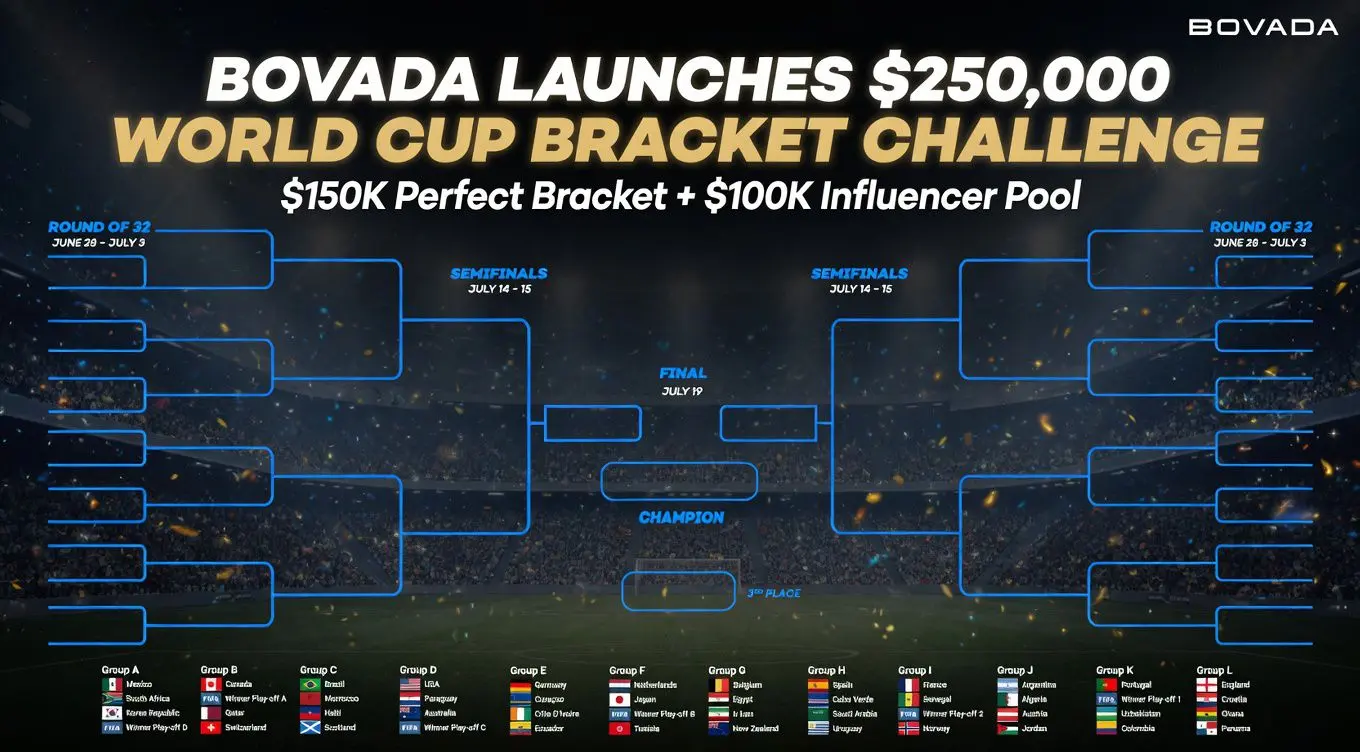
Bovada World Cup Bracket Challenge
Bovada’s World Cup Bracket Challenge is made for fans who want to predict the tournament from start to finish. The promo offers a $250,000 prize pool, including $150,000 for a perfect bracket and $100,000 tied to influencer team brackets.
Common mistakes to avoid with prediction markets
Ignoring liquidity. Thin markets have wide spreads. You can overpay to enter, only to struggle to exit. Stick to liquid markets when you can.
Treating price as certainty. A 70% contract still loses three out of ten times. The price is a probability, not a guarantee.
Skipping the fee math. Platforms take a cut on trades or winnings. Factor that into your expected return before you trade.
Not line shopping. Don’t assume the prediction market or sportsbook always has the better price. Compare both before committing.
Final word on World Cup prediction markets
Prediction markets are a fascinating addition to the World Cup betting landscape. They turn the crowd’s opinion into a tradable price. They’re great for reading sentiment and checking probabilities.
But for most bettors, a full-service sportsbook still offers more. More markets, more props, more parlays, and actual bonuses. The smartest approach? Use prediction markets as a research tool, then place your bets where the value and the betting options are best.
Bet responsibly
Trading contracts can feel like investing, but it’s still a form of gambling. Set a budget and stick to it. Never chase losses. Rapid price movements can tempt overtrading, so stay disciplined. If it stops being fun, take a break. Treat it as entertainment, not income.

World Prediction Markets FAQ
If you're looking to bet on the FIFA World Cup, you'll want to make sure you're familiar with the odds. Here are some of the most frequently asked questions about World Cup odds.
Yes, platforms like Kalshi and Polymarket carry World Cup markets. Kalshi is CFTC-regulated and available to US users, though availability varies by state. Polymarket runs on crypto and has faced US access restrictions in the past. Always check your local rules before trading.
Prediction markets focus on big-picture outcomes — tournament winner, which teams reach the final or advance from the group stage. They don’t typically offer the match-level detail a sportsbook does. No player props, no parlays, no live betting menus.
The contract price is the implied probability. A contract on Brazil to win the World Cup trading at 19 cents means the market gives them a 19% chance. Compare that directly to sportsbook odds by converting to implied probability — no extra math needed on the prediction market side.
For most bettors, sportsbooks offer more. You get player props, parlays, live betting, same-game parlays, and welcome bonuses — none of which prediction markets reliably provide. Prediction markets are most useful as a research tool to gauge public sentiment and check probabilities before placing bets at a book.
Very quickly. Prediction markets often move before sportsbooks because traders react instantly. A key injury or surprise group result will shift contract prices fast, sometimes before sportsbook lines have adjusted, which can tip off sharp bettors to where the value is moving.

Tony is a pro sports journalist who dedicates most of his free time to watching the latest matches and games on TV. When he's not participating in sports-related activities or seeing his friends, Tony enjoys outdoor activities such as hiking, cycling, and basketball. In addition to being a sports expert, Tony has extensive knowledge of finances and accou...
Read More About the Author Moneyline betting